
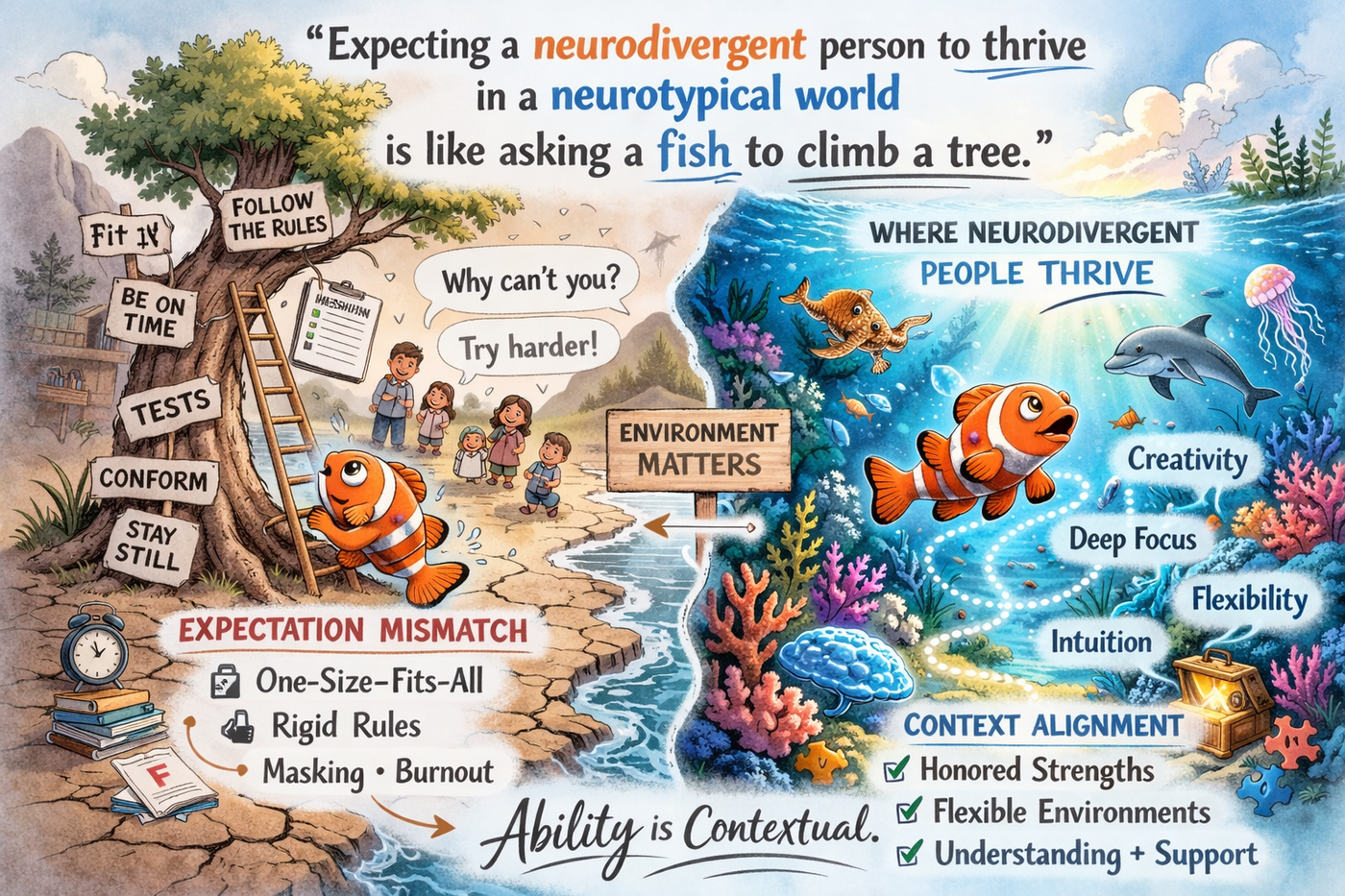
Imagine this….
Imagine if human brains ran on different "operating systems," like computers. Some run on Neurotypical (NT), the more common system, while others run on Neurodivergent (ND), which includes ADHD, autism, dyslexia, and other neurotypes.
This guide breaks down the key differences in how these "operating systems" process the world—not as defects, but as natural variations in human wiring.
1. Core Differences: NT vs. ND Brains
Feature | Neurotypical (NT) OS | Neurodivergent (ND) OS |
|---|---|---|
Information Processing | Linear, step-by-step thinking | Non-linear, "web-like" connections |
Social Communication | Instinctive, relies on unspoken rules | May need manuals (or misses hidden cues) |
Focus & Attention | Easily adjusts focus as needed | Either hyperfocuses or struggles to focus (no middle ground) |
Sensory Input | Filters out background noise easily | Overloaded (or understimulated) by sounds, lights, textures |
Routine & Change | Adapts to change smoothly | Needs routine—or rebels against it (depends on neurotype) |
Key Insight:
ND isn’t "broken NT." It’s a different framework—like iOS vs. Android, Mac vs. PC. Neither is wrong, but they work differently.
2. How Neurodivergence Changes the "User Experience"
A. Social Interactions
NT: Small talk is effortless; social rules are pre-installed.
ND: May feel like an "alien studying humans"—learning social scripts manually.
B. Work & Task Management
NT: Prioritizes tasks "normally" (whatever that means).
ND:
ADHD: Time-blindness, 0% or 100% focus.
Autism: Deep focus on passions, struggles with "irrelevant" tasks.
C. Emotional & Sensory Experience
NT: Emotions fit societal expectations; sensory input is background noise.
ND:
Emotions may be more intense or delayed.
Sensory input can feel like an unmuted firehose (or requires extra stimulation).
3. Why This Causes Misunderstandings
NT is the "default setting" in society, so ND behaviors are often misinterpreted:
ND Trait | NT Misinterpretation |
|---|---|
Not making eye contact | "Rude or hiding something" |
Hyperfocusing | "Obsessive" |
Stimming (fidgeting, humming) | "Disruptive" |
Direct communication | "Blunt or insensitive" |
Result: Many ND people mask (fake NT traits) to fit in—which is exhausting.
4. How to Navigate an NT-Dominant World as an ND Brain
If You’re Neurodivergent:
✅ Stop apologizing for your OS. Different ≠ defective.
✅ Find your "accessibility settings" (noise-canceling headphones, fidget tools, visual schedules).
✅ Seek ND communities—you’re not a glitch; you’re a unique model.
If You’re Neurotypical:
✅ Assume different, not deficient. Ask: "How does this person experience the world?"
✅ Offer clarity, not judgment. Example: "The meeting is at 3 PM sharp" vs. "Be there around 3."
✅ Normalize accommodations. Captions, flexible deadlines, and sensory-friendly spaces help everyone.
5. The Strengths of Neurodivergent Brains
ND isn’t just challenges—it’s a different kind of intelligence:
🔹 ADHD: Creativity, crisis-mode problem-solving, infectious enthusiasm.
🔹 Autism: Deep expertise, pattern recognition, honesty without hidden agendas.
🔹 Dyslexia: 3D thinking, narrative creativity, big-picture innovation.
(Many tech breakthroughs, art movements, and scientific discoveries came from ND minds!)
Final Thought: It’s Not a Bug—It’s a Different Codebase
Neurotypical and neurodivergent brains aren’t "right" or "wrong"—they’re different operating systems trying to run in the same society. Understanding this helps us:
Advocate for ND needs.
Design inclusive schools/workplaces.
Appreciate cognitive diversity as a human strength.
Question for You:
Do you see yourself more in the NT or ND framework? What’s one thing you wish others understood about your "OS"?
Want a deeper dive? Let me know if you’d like:
A printable comparison chart
Guides for specific neurotypes (AuDHD, dyscalculia, etc.)
Tips for ND self-advocacy
