Greetings 👋🏽
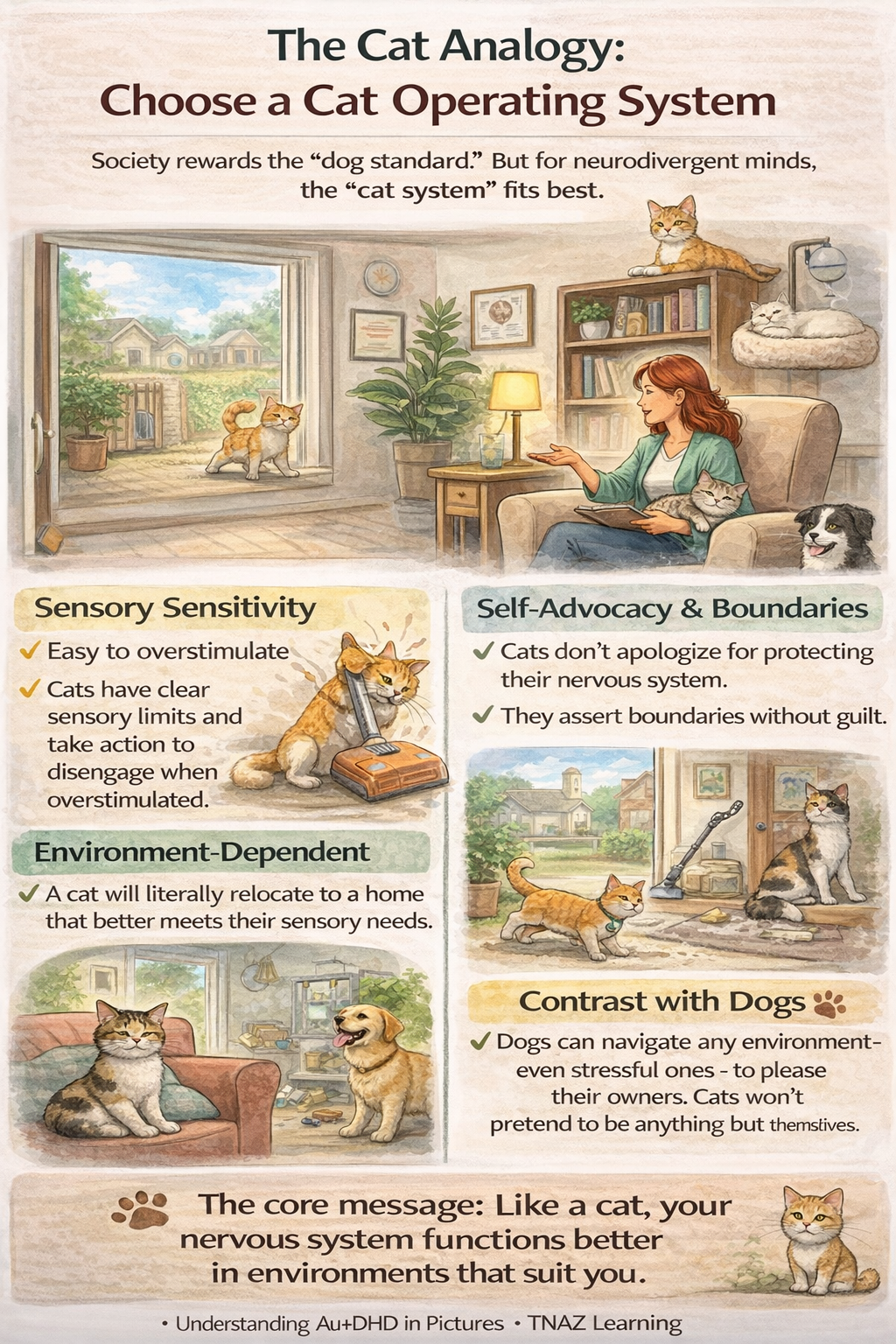
If you have ever owned a cat and a dog at the same time, you have probably realized that different animals have completely different nervous systems and behavioral patterns.
The dog likely greets every guest at the door with wild enthusiasm, regardless of whether they are in the mood for it. The dog adapts to your schedule, eats what is put in front of it, and generally tries its best to fit into the human world.
The cat, however, operates on a different frequency. The cat decides when it wants affection. It will let you know—loudly—if the food is unacceptable. And if the environment is too chaotic? The cat finds a high shelf, a quiet closet, or simply… leaves.
We are no different from our pets. Yet, for most of our lives, neurodivergent people are told we need to be more like the dog: flexible, social on command, and tolerant of any environment. But what if the key to our well-being lies in embracing our inner cat?
Here are four reasons why adopting a "cat mindset" is essential for Autistic, ADHD, and AuDHD individuals.
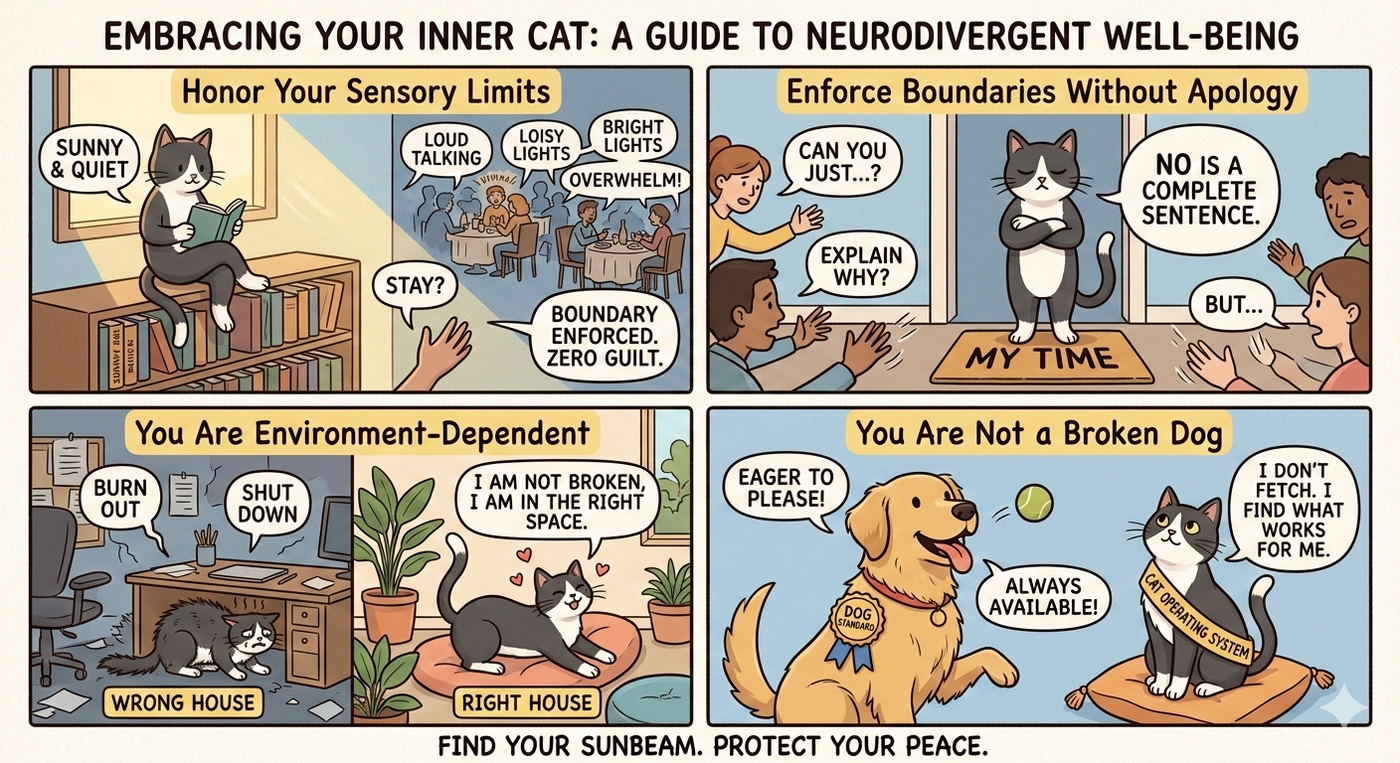
1. Honor Your Sensory Limits (The Art of the Escape)
Cats are masters of sensory awareness. They know exactly how much touch is too much. They know that the loud vacuum cleaner is a threat to their peace. When a cat reaches its limit, it doesn't worry about being polite. It simply removes itself from the situation. It walks away. It hides under the bed. It enforces its boundary with zero guilt.
Neurodivergent individuals often experience the world with the same intensity. The lights are too bright. The noise is too loud. The social interaction has gone on thirty minutes too long. But we have been trained to override these signals. We stay in the loud restaurant. We endure the hug. We smile until we crash.
The Cat Lesson: When you feel the "fur standing up on the back of your neck," it is a signal. You are allowed to leave. You are allowed to find a quiet corner. Protecting your sensory health is not rude; it is instinct.
2. Enforce Boundaries Without Apology
Have you ever tried to move a cat that doesn't want to be moved? It is impossible. A cat will go completely limp, or rigid, making it absolutely clear that the current situation is unacceptable. They don't explain themselves. They don't offer a five-point plan for why they prefer the blue cushion over the red one. They just… don't.
For neurodivergent people, boundary-setting can feel like a Herculean task. We often over-explain, people-please, and exhaust ourselves trying to accommodate others’ feelings while neglecting our own.
The Cat Lesson: Your needs are valid simply because they are yours. You don't need to justify your need for silence, your dislike of certain foods, or your requirement for alone time. A simple, "I can't do that right now," is a complete sentence.
3. You Are Environment-Dependent (And That’s Okay)
There is a fascinating phenomenon where a cat will simply "choose" a new home. Perhaps the old house had a dog that stressed them out, or the children were too loud. They find a new person, a quieter house, and move in. In the old environment, they were labeled "grumpy" or "antisocial." In the new environment, they are a "cuddly lap cat."
The cat didn't change. The environment did.
This is the reality for many neurodivergent people. In a loud, chaotic, or high-demand environment, we may struggle, burn out, or shut down. In a calm, structured, or accepting space, we thrive. We aren't broken; we are just in the wrong house.
The Cat Lesson: Stop trying to force yourself to function in environments that drain you. Start looking for—or creating—spaces where your nervous system can finally relax.
4. Remember: You Are Not a Broken Dog
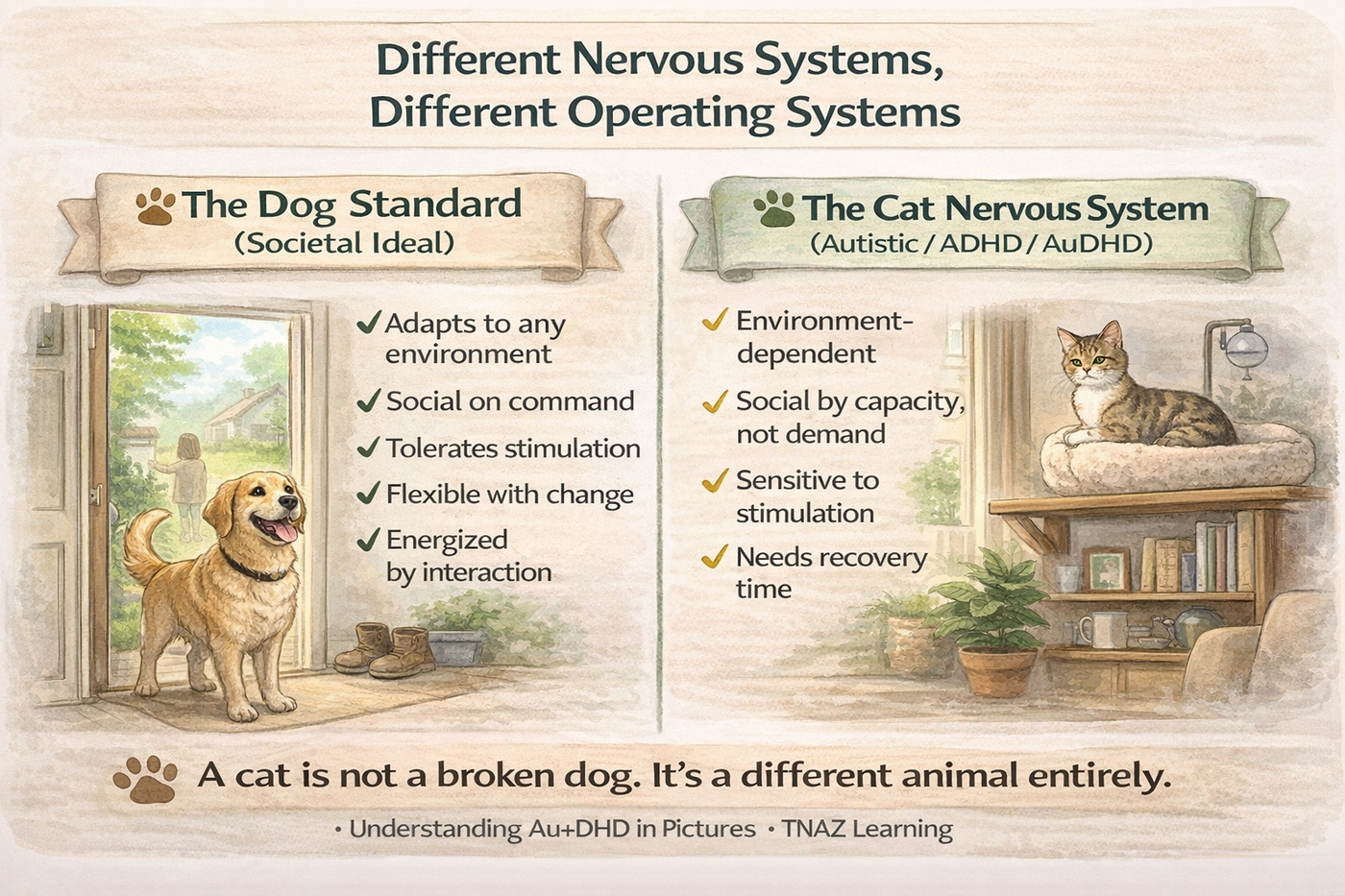
Society often operates on a "dog standard." The ideal employee is eager, adaptable, and thrives in open-plan offices. The ideal friend is always available and ready to socialize. When a cat fails to meet the dog standard, we call it "stubborn" or "difficult." But a cat isn't a failed dog. It is a different animal entirely.
Neurodivergent brains are not neurotypical brains that went wrong in the factory. They are wired differently from the ground up. Trying to live by neurotypical rules is like a cat trying to live by a dog's rules—it leads to exhaustion and a deep sense of being "wrong."
The Cat Lesson: Embrace your operating system. You don't need to fetch, roll over, or be happy about every visitor. You need to find what works for you.
The Purr-spective Shift
So, the next time you feel guilty for needing to cancel plans, for being "too picky" about your environment, or for retreating into solitude, think of the cat.
Your nervous system is telling you what it needs. Listen to it. Be a little more feline. Find your sunbeam, protect your peace, and don't be afraid to knock a glass off the counter when the world demands too much of you.