
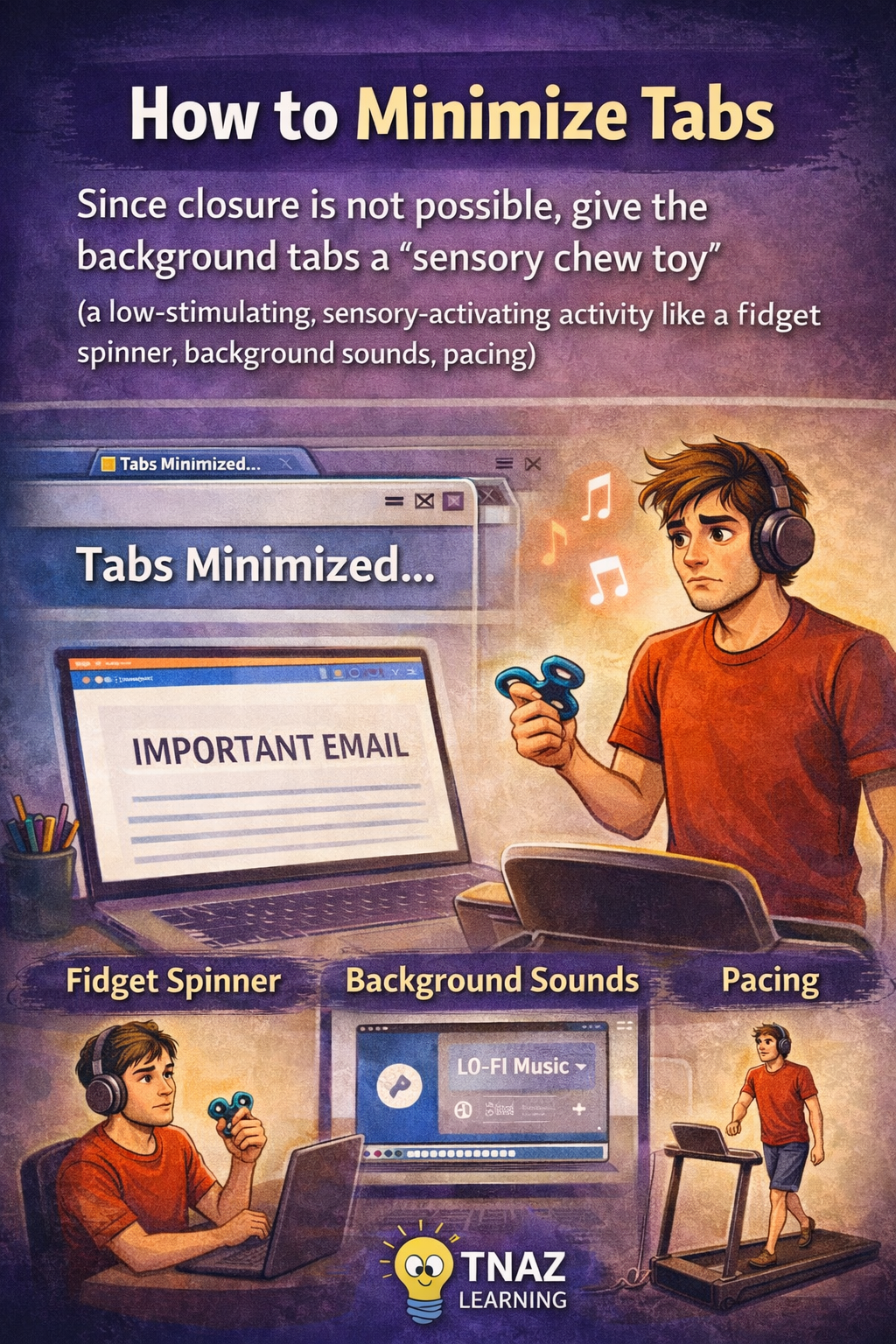
The "Two-Senses" Rule is a practical strategy based on the neuroscience of parallel processing in ADHD. It's a filter to help you choose effective background stimulation and avoid a "Cognitive Traffic Jam."
Here’s a breakdown of the rule, why it works, and how to use it.
What is a "Cognitive Traffic Jam"?
Imagine your brain's processing power is a multi-lane highway. In a neurotypical brain, focusing on a single task might just use one lane smoothly. In an ADHD brain:
The "boredom" or under-arousal can cause that lane to stall or shut down entirely.
To get it moving, you add a second task (like music) to open a second lane.
The Traffic Jam occurs when both tasks you're trying to run need the same cognitive lane. They merge, compete for resources, and everything grinds to a halt.
Example of a Traffic Jam: Trying to write an essay (which uses language processing) while listening to a podcast with spoken words (which also uses language processing). Your brain can't process two streams of language simultaneously—it leads to frustration, switching costs, and zero productivity.
The "Two-Senses" Rule Explained
The rule states: For effective parallel processing, your primary task and your background stimulation should primarily engage different senses and cognitive systems.
The Goal: To feed your brain's need for extra stimulation (the "second track") without creating direct competition for the specific neural resources your main task requires.
How to Apply the Rule
Choose a background activity that is:
Sensory-Distinct: Uses a different primary sense (e.g., auditory vs. visual, tactile vs. auditory).
Cognitively-Simple: Is repetitive, predictable, low-stakes, or non-linguistic, so it doesn't demand deep executive function.
Practical Examples
Primary Task (Track 1) | Good Background Stimulus (Track 2) - FOLLOWS the Rule | Why It Works | Traffic Jam Stimulus (What to Avoid) |
|---|---|---|---|
Reading/Writing (Visual, Language) | Instrumental music, white noise, nature sounds (Auditory, Non-Linguistic) | Sound occupies the auditory channel without hijacking the language centers. | Podcasts, audiobooks, music with lyrics (competes for language processing). |
Data Entry, Spreadsheets (Visual, Logical) | A podcast, documentary, or familiar TV show (Auditory/Narrative) | The narrative gives the DMN something to follow, freeing visual/logical centers for the task. | Complex visual media or fast-paced subtitles (competes for visual attention). |
Household Chores (Kinesthetic, Procedural) | Upbeat music, an audiobook, or a show on a tablet (Auditory/Visual) | The motor skills for chores are automatic; stimulation occupies the idle mind. | This is a flexible combo—just avoid tasks that require reading instructions simultaneously. |
Listening in a Meeting (Auditory, Linguistic) | Doodling, fidgeting, knitting (Tactile/Kinesthetic) | Tactile input provides rhythmic stimulation that anchors auditory attention, preventing drift. | Scrolling social media (competes for auditory attention and hijacks focus). |
Creative Thinking/Brainstorming (Internal, Conceptual) | Walking, pacing, or using a swing (Vestibular/Kinesthetic) | Movement stimulates the brain globally and can unlock creative networks without a competing cognitive stream. | Any demanding sensory input that pulls you out of your internal flow. |
If the Main Task is... | DO use this Background... | AVOID this Background... |
Reading / Writing | Brown Noise, Lo-Fi, Fidgeting | Podcasts, Pop Music with Lyrics |
Cleaning / Cooking | Audiobooks, TV Shows, Playlists | Silence (Brain will wander) |
Listening / Meetings | Doodling, Knitting, Walking | Checking Email, Texting |
Driving (New Route) | Silence or Instrumental | Heavy Talk Radio / High Stress Pods |
The Neuroscience Behind the Rule
This works because of how the brain is organized:
Modular Processing: Your brain has distinct, though interconnected, regions for processing language, sound, movement, and touch.
Cognitive Load Theory: You have a limited working memory capacity. The "Two-Senses" rule distributes load across different "buffers" (e.g., the visuospatial sketchpad vs. the phonological loop).
The DMN Pacifier: The right background task can engage the Default Mode Network (the daydreaming network) just enough to stop it from hijacking your primary task's cognitive resources.
Simple Takeaway
Before you add background stimulation, pause and identify the primary sense and cognitive demand of your main task. Then, choose a "second track" activity that leaves those specific channels free.
Task needs your EARS and WORDS? → Use your HANDS (fidget) or BACKGROUND SOUNDS (instrumental).
Task needs your EYES and ANALYSIS? → Use your EARS (podcast).
Task feels under-stimulating? → Add a predictable, rhythmic element to a different sense.
By consciously applying the Two-Senses Rule, you move from randomly seeking stimulation to strategically engineering your environment. You're not just avoiding distraction; you're building a custom cognitive scaffold that supports—rather than clashes with—your focus.
WORKSHEET
🧠 My Focus Map: Finding My "Second Track"
The Goal: To identify which "Processing Lane" your task uses and pair it with a background stream that keeps your brain engaged without causing a "traffic jam."
1. Identify Your Primary Task
Pick a task you struggle to start or finish.
Task name: __________________________________________________
Which "Lane" does it use most? (Circle one)
Verbal (Reading, writing, heavy thinking)
Motor (Cleaning, walking, repetitive hand movements)
Auditory (Listening to a meeting, lecture, or instructions)
2. Choose Your Background "Chew Toy"
Now, pick a background stream that uses a different lane than your primary task.
If your task is Verbal | If your task is Motor | If your task is Auditory |
Need to quiet the ears | Need to entertain the mind | Need to move the body |
[ ] Brown/Pink/White Noise | [ ] Podcast or Audiobook | [ ] Doodling or Sketching |
[ ] Video Game Soundtracks | [ ] A movie I’ve seen before | [ ] Fidget spinner / Stress ball |
[ ] 8D Audio (Instrumental) | [ ] High-energy Music | [ ] Standing desk / Walking |
[ ] Chewing gum / Ice | [ ] Phone call (Hands-free) | [ ] Knitting or Crocheting |
3. Create Your "Focus Formula"
Fill in the blanks below to create your plan.
"When I am (Primary Task) ____________________, I will use (Background Stream) ____________________ to keep my brain's 'Guard Dog' busy."
4. The "Check-In" (Trial & Error)
ADHD brains are highly sensitive to novelty. What works on Monday might not work on Wednesday. If you feel yourself getting distracted, ask:
Is there a Traffic Jam? (Are my background and my task fighting for the same lane? If so, change the background.)
Is the "Guard Dog" Bored? (Is the background too quiet or repetitive? If so, turn up the complexity—e.g., switch from White Noise to 8D Music.)
Is the "Guard Dog" Over-Excited? (Is the background so interesting I'm ignoring my task? If so, turn down the complexity—e.g., switch from a Podcast to a familiar TV show.)
💡 My Personalized "Menu"
List 3 combinations that usually work for you:
When I write emails, I listen to: ________________________
When I do the dishes, I watch/listen to: ________________________
When I am in a Zoom meeting, I: ________________________
