
Introduction
Have you ever had a week where you felt like your brain was a web browser with 50 tabs open, all playing music at the same time? You’re anxious, wired, and can’t sit still, yet you’re so exhausted you could cry.
Then, the moment the stressor is over—the trip is booked, the project is submitted, the social event ends—you don’t bounce back to "normal." Instead, you crash. Hard.
You feel hollow. Numb. You stare at the wall. You don’t want to see friends, and the thought of making a decision feels impossible. You might even have dark thoughts like, "If this is what life feels like, what’s the point?"
If this sounds familiar, you are not broken. You are not lazy. You are experiencing the ADHD Pendulum.
In a recent therapy session, we explored this exact dynamic using a simple but powerful metaphor: the Pendulum of Arousal. Understanding this concept is the first step to stopping the cycle of burnout and learning how to truly regulate your nervous system.
The Pendulum: Your Nervous System on a Swing
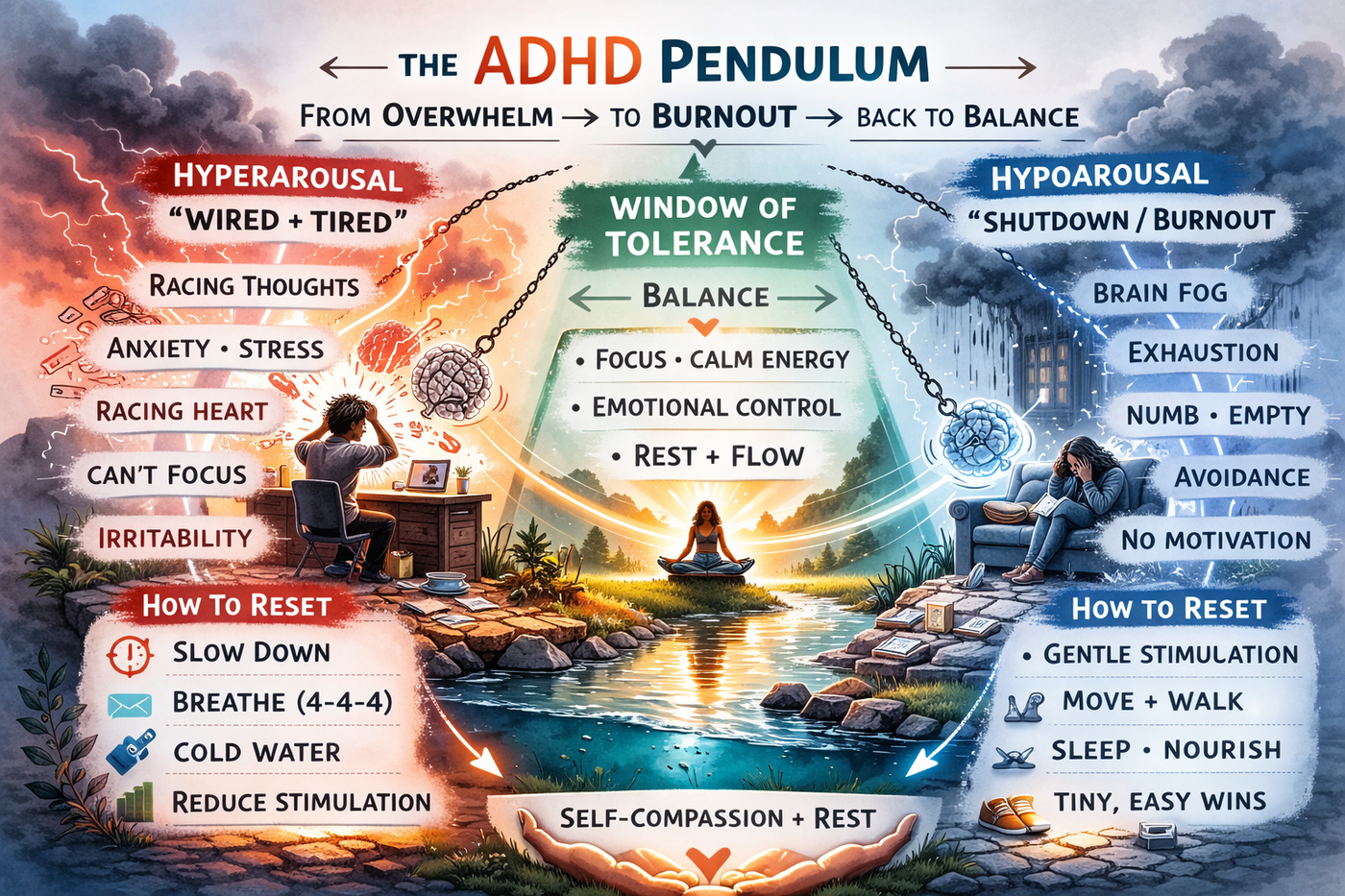
Imagine your nervous system is a pendulum. It swings back and forth between two extremes: Hyperarousal and Hypoarousal.
In an ideal world, this pendulum would only swing slightly throughout the day—a little energy when you need to work, a little rest when you need to sleep. This middle zone is called the "Window of Tolerance," or your Ideal State.
But for the ADHD brain, this pendulum often doesn't just swing; it flies off its hinges.
Here is what those two extremes look like.
1. Hyperarousal: The "Wired but Tired" State
This is your body’s Fight or Flight response. You enter this state when you are pushing yourself to meet a deadline, packing for a trip, or trying to force your brain to focus on a boring task.
What happens internally:
Because the ADHD brain struggles to produce dopamine during under-stimulating tasks, it triggers a stress response. It floods your body with adrenaline and cortisol to force you to focus. This is a chemical hack, but it comes at a cost.
What it feels like:
Mind: Thoughts are chaotic, racing, and impossible to organize. As the client in our session described it: "It felt like I was shooting a basket at a moving target all the time."
Body: Heart racing, muscles tense, easily startled by noise or lights.
Behavior: You’re reactive, irritable, and your ADHD traits become impossible to mask. Rejection Sensitivity Dysphoria (RSD) is at an all-time high.
Focus: Impossible. You want to do the thing, but your brain is too full of "noise" to execute.
2. Hypoarousal: The "Shutdown" State (Burnout)
If you stay in Hyperarousal too long, the pendulum eventually swings hard in the opposite direction to protect itself. This is the Freeze response. This is what we commonly call "burnout."
What happens internally:
Your battery is dead. Dopamine is completely depleted. The system has put up a "do not disturb" sign. It is not depression, but it can feel very scary because it mimics the numbness of a depressive episode.
What it feels like:
Mind: Brain fog, mental freeze, and a feeling of being "hollowed out." The client described it perfectly: "I am not sad. I'm just not anything... a lack of anything, no excitement."
Body: Profound exhaustion. You might sleep 12 hours and wake up just as tired. You’re physically sluggish.
Behavior: You avoid people and responsibilities. You might stare at the wall for hours or binge-watch a show you’ve seen a hundred times because it requires zero cognitive load.
Dark Thoughts: Because there is a void of feeling, your brain might panic and think, "If this is nothingness is all there is, I don't want to live it." This is the exhaustion speaking, not your true self.
The Danger of the "I Should" Trap
When you are in the Hypoarousal (burnout) state, the worst thing you can do is shame yourself with "I should" statements.
"I should be having fun, it's my birthday."
"I should be able to pack faster."
"I should go to that party."
In the session, the therapist noted: "I should and I have to are pitfalls for your neurotype. This is what keeps you from recovering."
When you are in the freeze state, your nervous system is telling you it needs protection and recovery. Pushing against it will only slam you back into Hyperarousal, creating a vicious cycle that deepens the burnout.
How to Get Back to Center
You cannot think your way out of a dysregulated state. You have to sense your way out. The key is to know which side of the pendulum you are on, and then nudge it gently back to the middle.
If you are in HYPERarousal (Chaotic/Wired):
You need to reduce stimulation and slow down your nervous system.
Cold Water: Splash ice-cold water on your face or hold an ice cube. This triggers the "mammalian dive reflex" and physically slows down your heart rate.
Deep Breathing: Inhale for 4, hold for 4, exhale for 4. This activates the parasympathetic nervous system.
Reduce Sensory Input: Turn off the music, dim the lights, and get out of loud environments.
If you are in HYPOarousal (Burnout/Freeze):
You need to gently increase dopamine without triggering more anxiety.
Low-Stimulation Fun: Do not force yourself to go to a loud party or do HIIT exercise. You need "chill fun." This might mean going for a walk, doing a mindless task like rowing, or watching a comfort show. "I just want to watch TV... More mindless," the client realized, which was a perfect instinct.
Tactile Grounding: Since your mind is foggy, use your body.
5-Finger Tracing: Trace one hand with the finger of the other. Breathe in as you trace up the finger, breathe out as you trace down.
Tense and Release: Lying down, tense your toes (breathe in), hold, and release (breathe out). Move up through your body.
State | What It Feels Like | The Goal | DO: Gentle Recovery Actions | DON'T: Harmful Traps |
|---|---|---|---|---|
HYPERAROUSAL (Fight/Flight) | "Wired but Tired" | Down-Regulate | • Cold Water: Splash face or hold ice (triggers dive reflex to slow heart rate). | • DON'T consume more caffeine or stimulants. |
HYPOAROUSAL (Freeze/Burnout) | "Hollow & Numb" | Up-Regulate Gently | • "Chill Fun": Watch a comfort show, mindless scrolling (on happy topics only). | • DON'T use "I should" statements ("I should be productive"). |
The Golden Rule for Recovery
In Hyperarousal: Your battery is overloading. You need to unplug.
In Hypoarousal: Your battery is dead. You need to trickle charge.
A Final Note on Self-Compassion
If you are reading this and recognize yourself in the "hollowed out" feeling, please know this: Your nervous system isn't broken; it’s just exhausted. It ran a marathon to get you through a stressful time, and now it needs to rest.
You do not need to earn rest. You do not need to justify your need for a quiet day.
Listen to the pendulum. If it has swung to burnout, your only job right now is to sleep, eat, hydrate, and engage in mindless, soothing activities. The energy for birthdays, bowling, and socializing will come back—but only after you’ve let your system recover.
