
Greetings 👋🏽
For a neurotypical person, boredom is just a mild lack of interest. However, for a neurodivergent brain, it’s a physiological state of deprivation.
Let’s break down what is actually happening…
The What: The Dopamine Drought ( The science)
ADHD is not a "lack of attention" disorder but as a dysregulation of attention. People with ADHD often have "too much" attention for stimulating tasks (hyperfocus) and "too little" for mundane ones. It is an executive function challenge, specifically in the ability to self-regulate where that attention goes.
Two of the most important ones for focus and motivation are Dopamine and Norepinephrine.
Dopamine is the "fuel" for the brain's reward and motivation center. It’s the chemical that says, "Hey, this is interesting, keep doing this." It’s the feeling of engagement.
Norepinephrine is like the brain's "alertness chemical." It sharpens focus, especially in response to stress or importance. It’s the feeling of urgency.
The problem: Your brain has difficulty maintaining a steady supply of these chemicals where they are needed most. You are running on a fuel leak. You are constantly looking for the next drop of fuel to keep the engine running.
Boredom is what happens when the fuel gauge hits E (EMPTY).
When a neurotypical person is bored, they may just feel a bit blah. When your brain hits a dopamine deficit, it doesn't just feel bored—it feels threatened. Your brain perceives the lack of stimulation as a crisis.
Neurological Reference
Dopamine and Norepinephrine Functions
Dopamine: Operates heavily in the Mesolimbic pathway (the reward circuit). It signals "incentive salience"—essentially telling the brain that a task is worth the effort.
Norepinephrine: Closely tied to the Locus Coeruleus, which regulates arousal and the "signal-to-noise" ratio in the brain. It helps the brain ignore distractions and stay alert.
In ADHD brains, these neurotransmitters are often cleared from the synapse (the space between neurons) too quickly by "transporters" before they can do their job, or the receptors are less sensitive. The "fuel leak" is a clinically resonant way to describe inefficient neurotransmission.
The Why: The Brain on Low Fuel
Why does it feel so painful? Because when you have no fuel, your brain’s executive functions start to struggle. Executive functions are the management system of the brain: prioritization, emotional regulation, and impulse control.
When you have dopamine (fuel), you can steer the ship.
When you run out of dopamine (boredom), the ship starts to sink.
Let’s Visualize This…
The "Neurotransmitter Fuel Gauge"
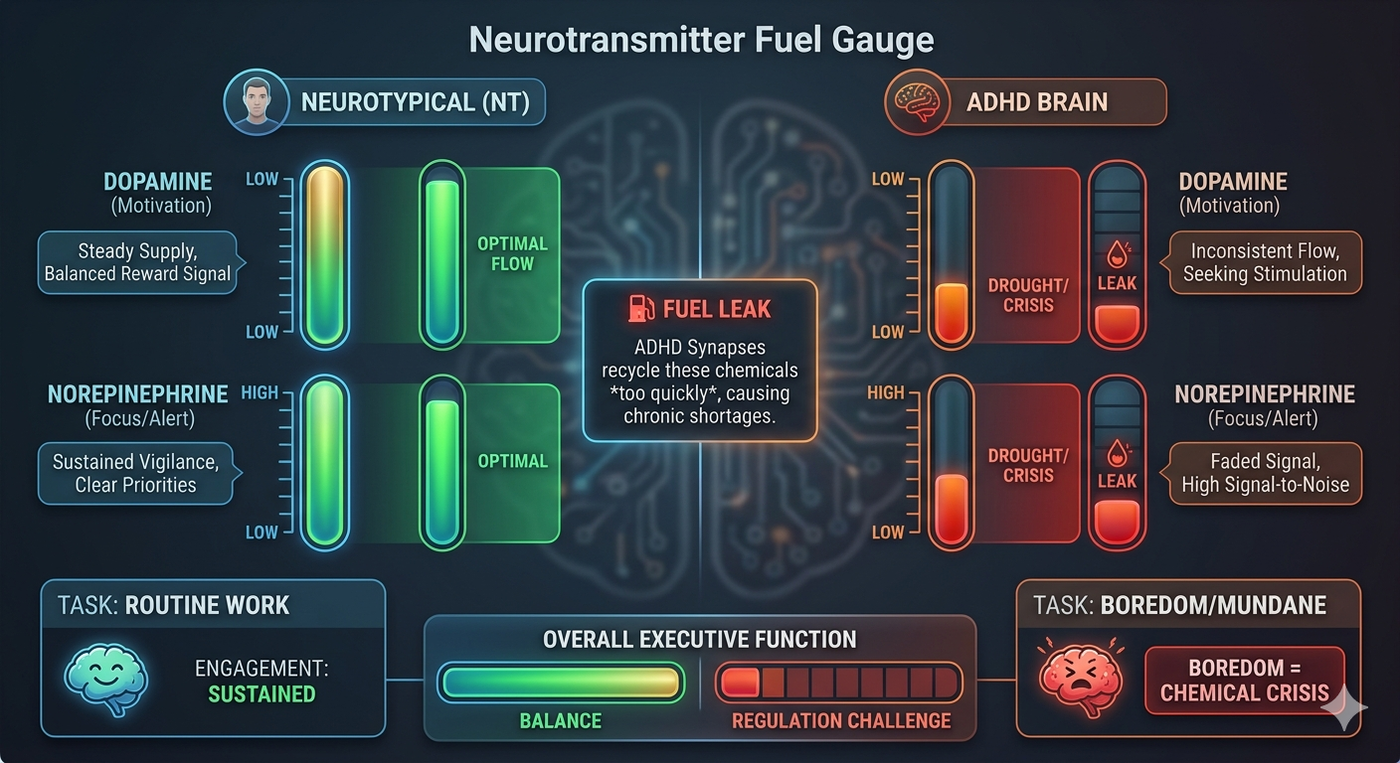
This is a dynamic visualizer that contrasts the chemical levels and task engagement of an ADHD brain versus a neurotypical brain. The key interaction here is seeing how chemical levels (Dopamine and Norepinephrine) directly affect motivation and mood.
What This Demonstrates:
Neurotypical Side: The gauges for Dopamine and Norepinephrine stay in a balanced, healthy green zone, even when doing routine tasks (like responding to emails or studying). They can maintain engagement because their "fuel supply" is stable.
ADHD Side: The Dopamine and Norepinephrine gauges fluctuate significantly. For stimulating tasks (like a favorite hobby), they might surge into a bright blue "Hyperfocus Zone." But for mundane or repetitive tasks, they quickly plummet into a red "Drought Zone," visually representing the "fuel leak."
The Clinical Detail: When both gauges hit the red "Empty" mark, a large icon labeled "BOREDOM/CRISIS" illuminates. This illustrates that for an ADHD brain, true boredom isn't just "blah"—it’s a physical state where the brain is chemically struggling to stay alert, triggering a sense of restlessness or urgency.
The Synaptic "Fuel Leak" Close-Up
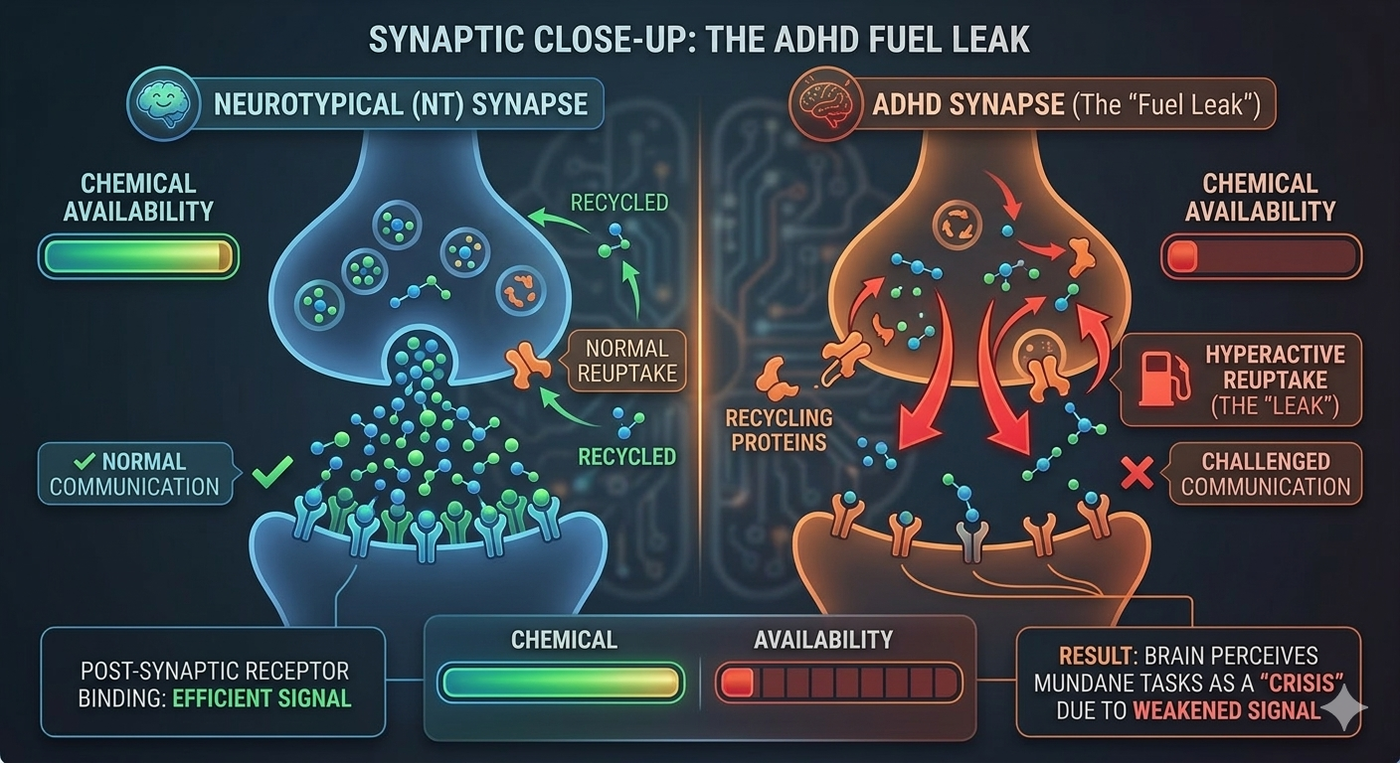
This diagram zooms in on the communication point between neurons (the synapse) to show exactly how the neurotransmitter fuel is lost, explaining the "why" behind the fuel gauge.
What This Demonstrates:
Neurotypical Synapse: The space is filled with neurotransmitters (small circles) connecting with multiple receptors (Y-shaped icons), creating a strong signal (labeled "ENGAGEMENT / ALERTNESS"). There are only a few transporter pumps (small squares) removing the neurotransmitters at a healthy, slow rate.
ADHD Synapse (The "Fuel Leak"): The synapse shows far fewer neurotransmitters available, and they are struggling to connect. You can clearly see a much higher number of active "Transporter Pumps," which are quickly sucking the chemicals out of the synapse before they can bind to the receptors. This creates a weak signal labeled "FOG / LOW MOTIVATION," and a large red arrow highlights this excessive chemical recycling as the "FUEL LEAK."
How This Feels (The Multiple Tabs Metaphor)
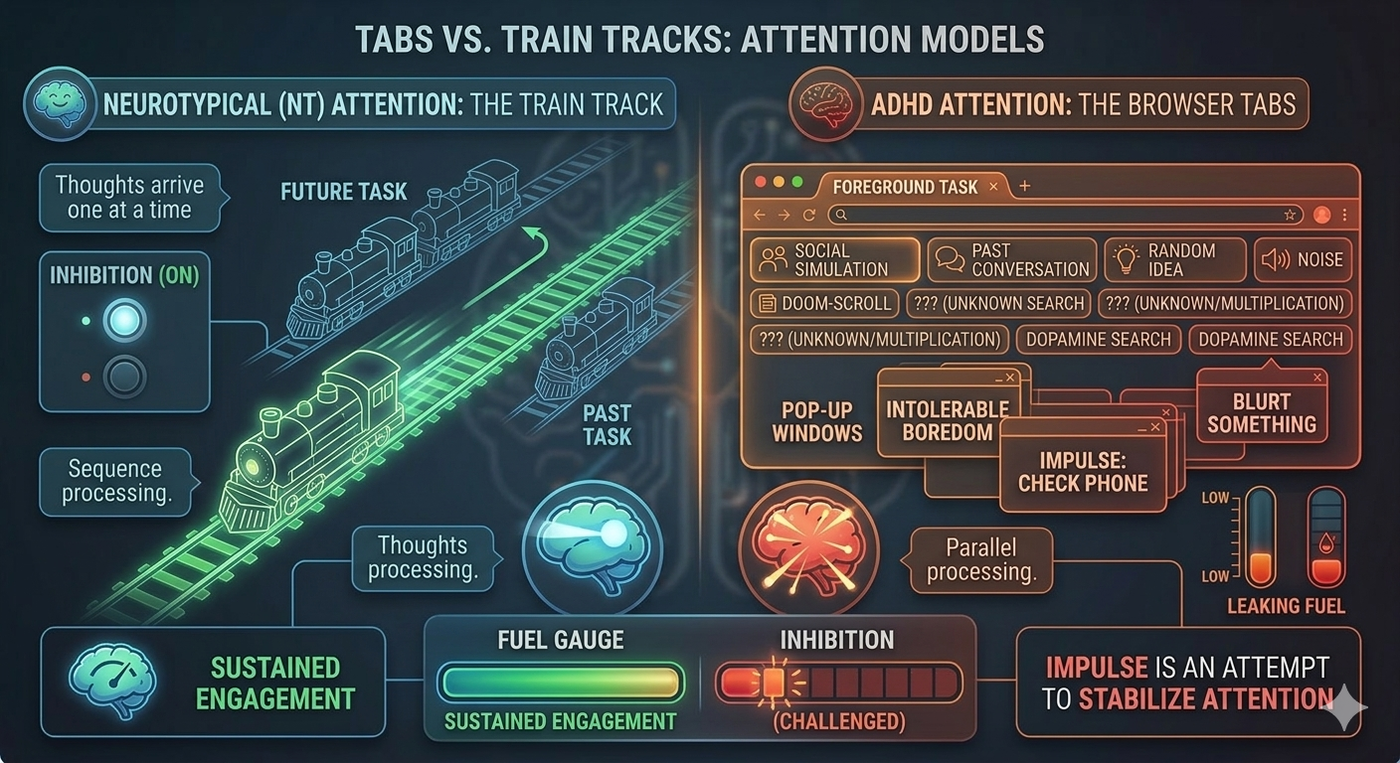
Let's build a better picture of how this feels.
Imagine a Neurotypical Mind like a Train Station or a Food Conveyor Belt.
Thoughts arrive one at a time, in a neat, orderly line. There is usually one active "thought train" on the track at a time. When a new thought appears, it tends to replace the previous one. Attention moves in a linear sequence. This allows for a steady, linear processing of information. It's efficient, manageable, and doesn't create much mental clutter.
Even when neurotypical people experience rumination (repeated thoughts on the same subject) or intrusive thoughts (thoughts that jump subjects), those thoughts usually take turns, rather than running simultaneously. Attention typically has one active channel at a time. So yes—they can ruminate, spiral, or get stuck. But it usually happens like this:
Thought A → Thought B → Thought C
Now, imagine an ADHD mind. It's like an internet browser with a completely different setting.
The ADHD brain functions more like an internet browser. And thoughts are like mental tabs:
🟦 There is a foreground tab (the task in front of you).
🟨 There are multiple background tabs (parallel thoughts running at the same time).
🟥 There are pop-up windows (intrusive thoughts, reminders, random ideas).
And here’s the key: The browser tabs don’t get closed, just minimized. They are always active and are competing to become the MAIN tab.
What This Feels Like:
Even when someone with ADHD is sitting quietly, their mind is often:
Running social simulations.
Noticing sounds.
Thinking about future tasks.
Replaying past conversations.
Generating new ideas.
When an ADHD brain is under-stimulated (aka the task is boring):
Background mental “tabs” multiply.
Pop-up thoughts increase.
The brain looks for dopamine to stabilize attention.
Therefore... impulsive actions are often not about recklessness. They’re attempts at regulation.
When someone without ADHD sees impulsive behavior—interrupting, doom-scrolling, grabbing a snack, switching tasks mid-sentence—it's easy to label it as "not thinking," "acting out," or "being careless."
But here's what's actually happening beneath the surface:
The ADHD brain is under-stimulated. The task at hand isn't providing enough dopamine to keep the engine running smoothly. So the brain goes hunting. It's not trying to be disruptive—it's trying to survive the boredom, the restlessness, the mental static.
That sudden urge to check your phone? That's your brain looking for a hit of novelty.
That impulse to blurt something out? That's your brain trying to engage before the thought evaporates.
That need to get up and walk away from your desk? That's your body saying "I can't focus here anymore—let me find somewhere else to try."
These aren't character flaws. They're coping mechanisms and can be sometimes inconvenient—but born from a nervous system that's desperately seeking balance.
THE ADHD THOUGHTS TAX
The costs of mental switching: exhaustion despite “ physically doing nothing”.
Every time the brain jumps from the foreground tab to a pop-up, it loses "RAM" (mental energy), which explains why the ADHD mind feels so exhausted at the end of the day despite "doing nothing."
Key reframe: “you are not lazy, your mind is multi processing…and that requires a great deal of energy. Your mind is using a lot of fuel to manage your thoughts…and that is doing ALOT…”
New Promise…”I will stop fighting my brain”
When you understand this, you stop fighting yourself and start working with yourself. You can ask: What's this impulse trying to regulate? Boredom? Under-stimulation? Overwhelm? And then you can give your brain what it actually needs—before it grabs something random instead.
Modern neuropsychological frameworks for understanding ADHD.
The "Linear vs. Parallel" Processing
Neurotypical attention is often described as a "bottleneck" or a "spotlight" that can focus intensely on one stream. In ADHD, there is a breakdown in Inhibitory Control.
The ADHD brain has difficulty "filtering out" irrelevant internal and external stimuli. While a neurotypical person can suppress background "tabs," the ADHD brain treats them as equally salient. This is why it feels like parallel processing rather than a single line.
The Working Memory Challenge
Working memory is the "mental workbench" where we hold information temporarily. People with ADHD often have a smaller " mental workbench" or difficulty clearing it. Because they struggle to prioritize which information is most important, thoughts remain "active" in the background (minimized) because the brain is afraid it will lose the information if the tab is fully closed.
3. Optimal Stimulation Theory
Optimal Stimulation Theory (OST) suggests that every individual has a unique, preferred level of mental and physical arousal (the "Optimal Level"). When we are at this level, we feel focused, calm, and capable. When we drift away from it, our brain takes action to get back to center.
1. The Homeostasis of the Mind
Think of your brain like a thermostat. It is constantly scanning to see if your environment is providing enough "data" to keep it running smoothly.
Over-stimulation: If there is too much noise, light, or complexity, the brain feels overwhelmed and seeks a way to "turn down the volume" to avoid anxiety.
Under-stimulation: If an environment is too quiet, repetitive, or boring, the brain feels starved of input. It enters a state of hypo-arousal, which can feel like restlessness or even physical discomfort.
However for people with ADHD…
For people with ADHD, the "Optimal Level" is often higher than it is for neurotypical individuals. This is frequently linked to lower baseline levels of dopamine.
Because the "thermostat" is set higher, an environment that feels "peaceful" to a neurotypical person may feel "painfully under-stimulating" to someone with ADHD. This leads to stimulation-seeking behaviors:
Fidgeting or pacing.
Checking a phone for novelty.
Seeking out high-interest or high-stakes activities.
Distractibility becomes a regulatory tool
OST reclaims "distractibility" as a regulatory tool. If the brain isn't getting enough stimulation from a primary task (like a boring meeting), it will "hunt" for it elsewhere to try and reach that optimal state of arousal where it can function again.
The Default Mode Network:
In ADHD, the "Default Mode Network" (the part of the brain responsible for internal thoughts and "social simulations") often stays active even when the "Task Positive Network" (the part that does the work) is supposed to be in charge. It’s like the browser running two heavy programs at once.
The Backup Generator: Two Very Different Kinds of Fuel
Here is where it gets really interesting. Your brain has a fail-safe. It knows that Dopamine is the preferred fuel—it’s smooth, clean, and sustainable. It’s the feeling of being engaged with a hobby or a fascinating conversation.
But when the dopamine fuel runs dry and the boredom alarms are screaming, your brain will panic and kick on the backup generator. However, this generator runs on a completely different type of fuel: Adrenaline (and its close cousin, Norepinephrine).
To understand this, we have to look at the two fuel sources side-by-side.
Fuel Type #1: Dopamine (The Preferred ‘Clean’ Fuel)
Source: Interest, novelty, challenge, completion, pleasure.
Experience: Feels like flow, engagement, curiosity. "I want to do this."
Sustainability: High. You can do a thing for hours if the dopamine is flowing.
The ADHD Challenge: It drains fast.
Fuel Type #2: Adrenaline / Norepinephrine (The Emergency Diesel)
Source: Fear, urgency, stress, conflict, a looming deadline.
Experience: Feels like anxiety, panic, pressure. "I have to do this or something bad will happen."
Sustainability: Low. It burns hot and dirty. It crashes hard and leaves you exhausted.
The ADHD Hack: Your brain knows this works. If you can't find "want-to," you can always manufacture "have-to."
Think of anxiety as the loud, smoky, diesel-powered generator compared to the clean solar power of dopamine. It’s not comfortable, it’s noisy, and it shakes the whole house, but damn it, it creates juice.
This is why so many people with ADHD are also expert procrastinators. You wait until the last minute to write the paper. Suddenly, the fear of failure (anxiety) kicks in. The generator roars to life, flooding your system with norepinephrine—the volume knob for focus. It sharpens your attention to a laser point. You just wrote a whole paper in two hours.
This is also why an ADHD brain can sometimes turn small worries into full-blown catastrophes in their mind. If you can't find the dopamine to get interested in your chores, your brain might subconsciously decide to worry about your chores instead. Worrying creates anxiety, anxiety creates adrenaline/norepinephrine, and that chemical mix is a valid (though terrible) fuel source.
The ADHD DIESEL TAX:
You are essentially setting a small fire in your living room just to have the energy to get off the couch to call the fire department. It works, but it's destroying the house.
The Behavioral Consequences:
When your brain is this dysregulated (or running on dirty anxiety fuel), your behavior follows suit.
1. The Conversation Hijack (Interrupting)
You’re in a conversation. The person you’re talking to is explaining something slowly. Your fuel gauge hits zero.
Your brain, desperate for stimulation, scans the room for dopamine. It finds a thought related to what they are saying. "Aha! A thought! That feels like fuel!"
Before your impulse control (which is offline due to low fuel) can stop you, you blurt it out. You interrupt them.
It’s not that you don’t care what they have to say. It’s that your brain was so desperate for the relief of thinking something stimulating that it bypassed your impulse control.
2. Impulsivity (The "Do Something Crazy" Button)
Boredom is so uncomfortable for the ADHD brain that we will seek negative stimulation just to escape the numbness.
Buying something expensive online? (Dopamine hit!)
Picking a fight with your partner? (Conflict creates adrenaline/norepinephrine!)
Eating an entire bag of sugar? (Instant fuel!)
Checking social media for the 100th time? (Maybe there's something new!)
New Reframe..
“ I am not doing these things to be difficult. My mind is doing them to make the "pop-ups" stop and to get the engine running again.”
3. The Anxiety Spiral
Because we rely on the anxiety generator so often, we can get stuck in a loop. You’re bored, so you procrastinate. Procrastination creates anxiety. Anxiety fuels focus via norepinephrine. You do the thing. But now your brain has learned a dangerous lesson: "The only way to get fuel is to wait until I'm terrified."
This trains you to avoid starting things until the backup generator kicks on, which is exhausting and terrible for your long-term peace of mind.
What To Do About It? (Damage Control)
Since we can't magically create more dopamine receptors, we have to manage the fuel supply and learn to turn off the backup generator when we don't need it.
Recognize the "Boredom Panic": When you feel that skin-crawling sensation, label it. Say to yourself, "Ah, my fuel is low. My brain is freaking out because it thinks it’s dying. I don't actually need to move to Alaska." Labeling it takes away some of its power.
Stimulate Strategically: If you have to do a boring task, give your brain permission to engage your background tabs with “energizing stimulants”.
Examples of “energizing stimulants”
Listen to a podcast or music while you work (gives the background tabs something to do).
Use a fidget toy. It provides just enough stimulation to keep the background noise quiet so the Focus Tab can work.
The Pause Before the Pop-up: When you feel the urge to interrupt or impulse-buy, try a micro-pause. Take one deep breath. Ask yourself: "Is this a genuine thought, or is my bored brain just throwing up a pop-up to get dopamine?"
Thank the Generator (But Don't Live in It): When you notice you are spiraling with anxiety about a task, thank your brain for trying to help. Then, try to feed it a tiny piece of dopamine instead.
Do a small, fun part of the task first.
Put on music you love.
Light a nice candle.
Give your brain a reason to want to do the thing—to find the clean energy—before the deadline panic sets in.
