
INTRODUCTION:
Getting stuck and unable to focus is frustrating, but you don't have to fight it with sheer willpower. Use this quick guide to troubleshoot your brain and create the right conditions for focus to happen.
Step 1: The Body Check-In (Anxiety Scan)
Before you can tackle your to-do list, you need to see what your nervous system is doing. Close your eyes for 10 seconds and scan your body.
Where do you feel tension? (e.g., clenched jaw, tight shoulders, racing heart)
Are you feeling restless, on edge, or overwhelmed?
If YES, you're likely anxious: Your brain is in "threat detection" mode, not "focus" mode. Don't try to push through it. First, you need to regulate.
Step 2: Ground the Engine (Calming Anxiety)
Here's something surprising: anxiety isn't just in your head—it's in your body too. Racing thoughts? That's the mind. Heart pounding, shallow breathing, tight muscles? That's the body. And you can't think your way out of a body state. Telling yourself to calm down when your nervous system is on high alert? Doesn't work.
Instead, use a two-part approach. First, ground yourself using your five senses—think of this as the emergency brake for an anxious mind. Then, once you're settled, you can work on the thoughts themselves.
Try one of these ADHD-friendly grounding techniques—choose the sensory input that works for you:
Sight: Watch a lava lamp, a crackling fire video, or a glitter wand
Touch: Hold an ice cube, take a hot shower, or wrap up tight in a weighted blanket
Sound: Crank up rhythmic music (drums work great) or white noise
Smell: Inhale a strong scent like peppermint or eucalyptus
Quick check: Did you take your medication today? If not, now's the perfect time. Meds help these tools work better.
Once your heart rate slows and you feel more present, you're ready for Step 3.
The Medication Reminder: If you are prescribed medication, ask yourself: Did I take it? If not, this is your cue to do so. Medication is a tool that helps make these other steps more effective.
Once your body feels calmer and your heart rate has slowed, move to Step 3.
Step 3: Entertain the Background Noise (Channeling Chaos)
Now that you're calm, check your headspace. Is it still noisy? Are thoughts bouncing around like ping-pong balls? If your brain is "boring" you with its own internal chaos, you need to give it a gentle, external distraction to keep it occupied.
The "Sensory Chew Toy": Your brain needs something to nibble on so it stops trying to eat the main task. This is a low-stimulation background activity.
The 2-Sense Rule (Crucial!): To avoid a "cognitive jam," your main task and your background sensory input must use different channels.
If your main task is VISUAL (reading, writing, coding): Your background stimulation should be AUDITORY or TACTILE.
Good: Lo-fi music (sound), a fidget cube (touch), white noise (sound).
Bad: Watching a video (visual + visual = overload).
If your main task is AUDITORY (on a Zoom call, listening to a lecture): Your background stimulation should be VISUAL or TACTILE.
Good: Doodling (visual), a stress ball (touch), a visual stim toy like a spinner (visual).
Bad: Tapping your pen loudly (auditory + auditory = overload).
If your main task is PHYSICAL (cleaning, data entry): Your background stimulation can be AUDITORY.
Good: An audiobook or a podcast.
Step 4: The Boredom Bypass (Boosting the Task)
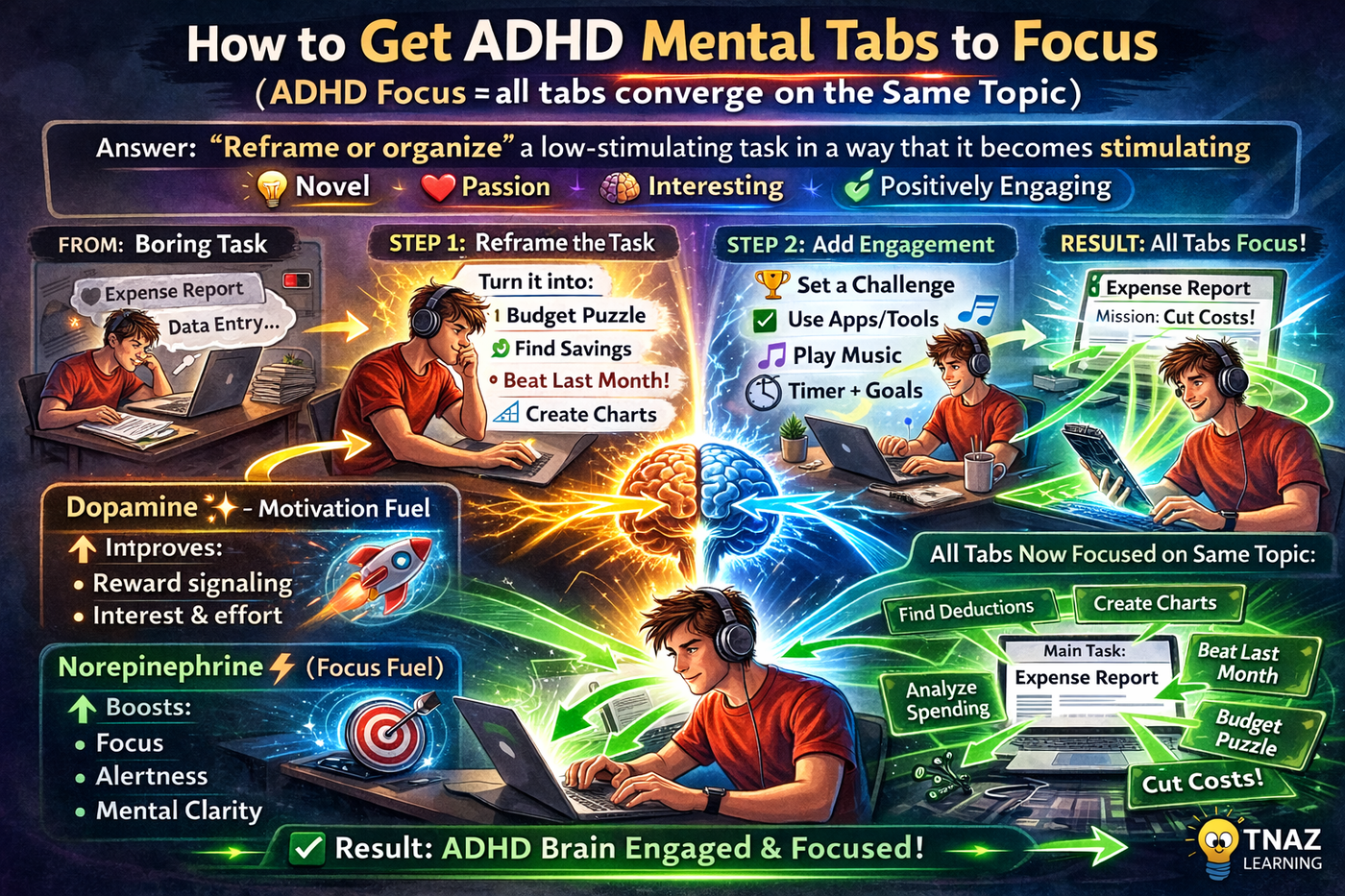
Sometimes the task itself is just too low-stimulation for your ADHD brain to care about. If the task is boring, your brain will reject it. You have to make it worth its while.
Pair it with a Reward: Strictly limit a high-dopamine activity for only when you are doing the boring task.
Example: "I can only listen to my favorite true-crime podcast while I'm doing the dishes or filing these reports."
Example: "I can only drink this fancy iced coffee while I'm answering these emails."
Reframe the Task: Add a layer of artificial excitement or challenge.
Gamify it: "Can I get this done before this 3-minute song ends? Can I beat my time from yesterday?"
Add a Narrative: Pretend you're a secret agent who has to decode the document. You're not just cleaning the kitchen; you're a celebrity's personal assistant preparing for a surprise inspection.
When the Strategies Feel Like They're Failing
You’ve tried the body check, the grounding, the fidgets, and the reframes. You’re still staring at the screen. Now what?
1. Try Body Doubling.
This is non-negotiable for many ADHDers. It doesn't mean working together; it means working alongside someone.
How: Go to a coffee shop, sit at the kitchen table with a roommate (who is doing their own thing), or use a free online body doubling service (like Focusmate).
Why it works: The gentle social presence of another person helps your brain stay in "focus mode" because someone might see you get distracted. It lowers the anxiety of being alone with a boring task.
2. The "Emergency Focus" Release Valve.
If body doubling doesn't work, you have one final, biological option. It’s not pretty, but it’s real.
Stop. Consciously, deliberately, stop trying. Go do something else that is more stimulating—scrolling, a video game, a walk, a snack. Give up the fight for now.
Wait for the Panic Monster: At some point, the deadline (or the guilt of the open loop) will get close enough that your brain switches into survival mode. Adrenaline will surge. Your brain will decide that the pain of not doing the task is greater than the pain of doing it. This is the "Emergency Focus" mode.
The Permission Slip: If this happens, do not add shame on top of it. Do not tell yourself, "Ugh, I'm such a procrastinator, I only work well under pressure." Instead, say: "There is my nervous system kicking in to save me. Thank you, brain. Let's use this window of panicked energy to get this done." Allow the process to just be what it is. Use the adrenaline, get it done, and then rest.
The Golden Rule: What NOT To Do When You Can’t Focus
This is the most important part of this entire guide. There is one action that will guarantee you stay stuck: Forcing it.
DON’T: Try to Force Focus.
When you try to physically pin your brain down and force it to concentrate, you trigger an immediate anxiety response. Your brain perceives this struggle as a threat.
The Shame Spiral (How to Avoid It):
You can't focus (Symptom).
You try to force it (Strategy).
You fail to force it (Inevitable Result).
You feel shame/anger at yourself ("Why can't I just do this simple thing?").
This shame triggers The Wall of Awful. The task is no longer just a task; it is now a symbol of your failure. It feels huge and impossible.
Result: Task inertia (freezing), low mood, and even more distractibility.
Remember This Mantra:
The ADHD nervous system is environment dependent. It is not willpower deficient.
You do not need to become a more focused person. You need to build a more supportive environment. Your only job when you are stuck is to stop fighting yourself and start adjusting the room, the sound, the body, or the company.
Negative Distractions: Also, be aware of your environment. If "negative distractions" are present (a buzzing phone, an open tab with social media, a cluttered desk), your environment is fighting against you. Clear the negative distractions first, then build the positive sensory environment.
