
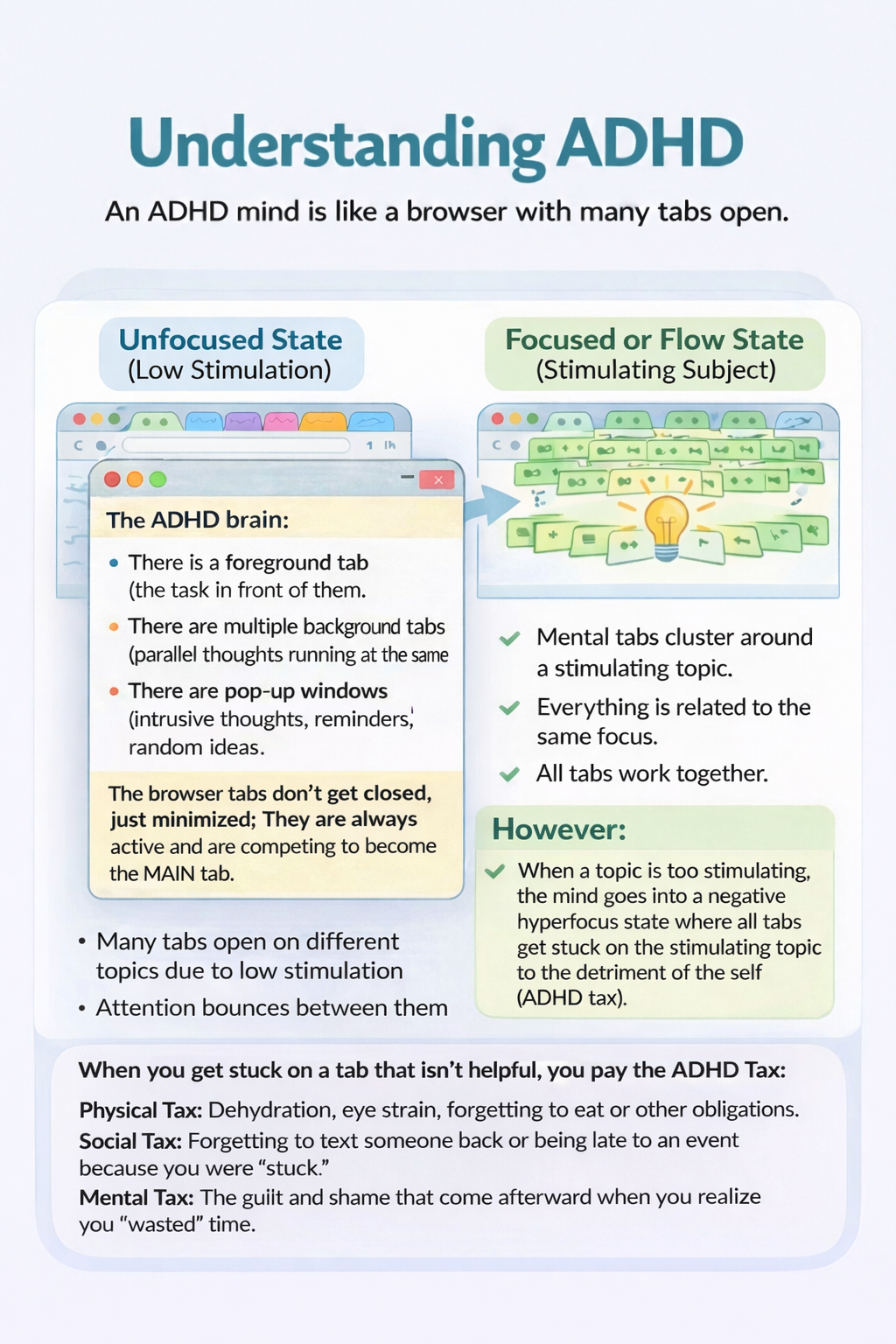
“If you have ADHD, your brain isn’t unfocused — it’s just running a lot of tabs.
For a neurotypical mind, headspace is like a train station or a food conveyor belt. Thoughts arrive one at a time, in a neat, orderly line.
There is usually one active ‘thought train’ at a time
When new thoughts appear, they tend to replace the previous one
Attention moves in a linear sequence. This allows for a steady, linear processing of information. It's efficient, manageable, and doesn't create much mental clutter.
Even when neurotypical people experience:
rumination (repeated thoughts on the same subject), or
intrusive thoughts (thoughts that jump subjects),
those thoughts usually take turns, rather than running simultaneously.
Attention typically has one active channel at a time.
So yes — neurotypical folks can ruminate, spiral, or get stuck. But it usually happens like this:
Thought A → Thought B → Thought C
Now, imagine an ADHD mind. It's like an internet browser with a completely different setting.
The ADHD brain functions more like an internet browser. And thoughts are like mental tabs
🟦 There is a foreground tab (the task in front of them).
🟨 There are multiple background tabs (parallel thoughts running at the same time).
🟥 There are pop-up windows (intrusive thoughts, reminders, random ideas).
And here’s the key:
The browser tabs don’t get closed, just minimized; They are always active and are competing to become the MAIN tab.
What This Feels Like
Even when someone with ADHD is sitting quietly, their mind is often: Running simulations; Noticing sounds; Thinking about future tasks; Replaying conversations; Generating new ideas;
When an ADHD brain is under-stimulated ( aka the task is boring):
Background mental “tabs” multiply; Pop-up thoughts increase; The brain looks for dopamine to stabilize attention.
Therefore...
Impulsive actions are often not about recklessness. They’re attempts at regulation.
What do we mean by this?…
When someone without ADHD sees impulsive behavior—interrupting, doom-scrolling, grabbing a snack, switching tasks mid-sentence—it's easy to label it as "not thinking," "acting out," or "being careless."
But here's what's actually happening beneath the surface:
The ADHD brain is under-stimulated. The task at hand isn't providing enough dopamine to keep the engine running smoothly. So the brain goes hunting. It's not trying to be disruptive—it's trying to survive the boredom, the restlessness, the mental static.
That sudden urge to check your phone? That's your brain looking for a hit of novelty.
That impulse to blurt something out? That's your brain trying to engage before the thought evaporates.
That need to get up and walk away from your desk? That's your body saying "I can't focus here anymore—let me find somewhere else to try."
These aren't character flaws. They're coping mechanisms. Clumsy, sometimes inconvenient—but born from a nervous system that's desperately seeking balance.
When you understand this, you stop fighting yourself and start working with yourself. You can ask: What's this impulse trying to regulate? Boredom? Under-stimulation? Overwhelm? And then you can give your brain what it actually needs—before it grabs something random instead.
Flow or Focus State: Dopamine is needed to regulate these tabs.
But when the subject is interesting or stimulating, something different happens.
All those background tabs shift to different aspects of the same topic. Focus still moves — but it stays on the subject.
All those scattered mental tabs cluster together around one interesting topic. Everything connects. Ideas build on each other.
They aren't fighting for attention anymore; they’re working in perfect harmony. In this state, the ADHD brain is a high-performance engine. It’s laser-focused, creative, and incredibly fast.
This type of thinking process is called parallel processing.
And sometimes, the brain gets stuck…
However, there is a catch. When a topic is too stimulating, the mind don't just focus—it gets stuck. This is "negative hyperfocus" — a kind of negative hyperfocus where switching subjects becomes difficult. That’s often where the ADHD tax shows up.
The Physical Tax: You forget to eat, your eyes strain, and you realize you haven't moved for four hours.
The Social Tax: You miss texts or show up late because you literally lost the concept of time.
The Mental Tax: That heavy weight of guilt when the spell finally breaks and you realize how much time was "wasted."
Takeaways:
So the difference isn’t motivation or intelligence. It’s that some brains process thoughts one at a time (Neurotypical- linear processing) . Other brains process many thoughts at once ( ADHD- parallel processing). Once you understand that, hopefully a lot of the confusion — and a lot of shame starts to fall away.
Having ADHD isn’t a lack of attention…
The real struggle of ADHD is regulating focus—turning it on when you need it, and crucially, turning it off when you need to stop.
Hyperfocus Vs Flow State
Feature | Flow State (Controlled) | Hyperfocus (The "Stuck" Tab) |
Choice | You usually choose to enter it. | It often "grabs" you unexpectedly. |
Awareness | You are aware of your surroundings. | You might not hear someone say your name. |
Exit | You can stop when you need to. | You feel "locked in" until the dopamine runs out. |
Outcome | Leaves you feeling energized. | Often leaves you feeling "hungover" or depleted. |
Dopamine’s Role
What is dopamine?
The ADHD brain has a chronic shortage of dopamine—the neurotransmitter responsible for motivation and "reward." When you stumble upon a new, weird topic (like the salt trade in the 14th century), your brain gets a sudden spike of dopamine.
To your brain, that salt history isn't "useless trivia"; it’s fuel. Your brain will latch onto that "tab" and refuse to let go because it's finally getting the stimulation it craves.
Therapist Version
Title: ADHD Attention as Parallel Processing
“A helpful way to understand ADHD attention is through a browser-tab metaphor.
In the unfocused state, the ADHD brain holds multiple mental ‘tabs’ open simultaneously.
Each tab represents a thought stream, task, memory, or sensory input competing for attention.
This reflects parallel processing — a cognitive style in which the brain processes multiple streams of information at the same time, rather than completing tasks sequentially.
In contrast to serial processing (one task, then the next),
parallel processing distributes attention across several active channels simultaneously.
This explains why ADHD is often misinterpreted as distractibility or lack of effort.
The issue is not insufficient attention, but how attention is allocated.
Traditional advice like ‘just focus on one thing’ asks a parallel processor to behave like a single-threaded system — a mismatch in expectations.
When interest, novelty, or relevance is present, the system reorganizes.
The tabs do not close — they cluster.
In the focused state, multiple cognitive streams align around a shared topic or goal.
Attention becomes integrated rather than divided, allowing for sustained, deep engagement.
Clinically, this reframes ADHD focus as an issue of alignment rather than control.
The therapeutic task is not to reduce cognitive activity,
but to help clients identify conditions that allow their parallel processes to converge.
When this occurs, the ADHD brain often demonstrates exceptional creativity, insight, and persistence.”
Script to say to explain this to family/friends
Most people think of ADHD as just being "distracted," but the reality is often the opposite: we get too focused. Think of my brain like a web browser. Usually, my attention is bouncing between dozens of open tabs because I'm under-stimulated.
But when I find something highly stimulating, my brain doesn't just "focus"—it locks on. This is negative hyperfocus, and it comes with a heavy "tax" that I pay in three specific ways:
1. The Physical Tax
When I’m in a "stuck state," my brain ignores my body’s basic signals.
Impact: I might experience severe dehydration or eye strain.
Impact: I often forget to eat or handle basic physical obligations.
The Reality: I'm not "choosing" the rabbit hole over my health; my brain has temporarily lost the ability to "click away".
2. The Social Tax
This is often the hardest part for others to understand.
Impact: I might forget to text someone back or completely lose track of time.
Impact: It causes me to be late to events because I was "stuck" on a stimulating topic.
The Reality: It isn't a lack of care for the other person; it's a breakdown in Task Switching—the mental muscle required to move from one activity to another.
3. The Mental Tax
Even when the "stuck" state ends, the tax continues.
Impact: There is an overwhelming sense of guilt and shame that comes afterward.
Impact: I feel a deep frustration when I realize I "wasted" time on something unhelpful while important tasks went unfinished.
The Reality: This mental fatigue makes it even harder to start the next task, creating a cycle of exhaustion.
The Bottom Line: If you see me stuck in a rabbit hole, please understand that I’m not being "lazy" or "ignoring" the world. I’m currently paying a tax I never signed up for.
How they can support you
1. The Gentle Nudge (For early-stage sticking)
Instead of saying "Stop doing that," which can trigger a defensive response, they can try:
"Hey, I noticed your 'tabs' are clustering really hard on [Topic]. Do you want to take a 5-minute 'browser refresh' with me?"
"Checking in—how's your 'battery' doing? Do you need a glass of water or a snack?"
2. The "Bridge" Strategy (To help with Task Switching)
The hardest part is the "friction" of stopping. They can help by building a bridge to the next task:
"I see you're deep in the salt history rabbit hole. In ten minutes, I’m going to start the movie. I’ll come back then to help you 'close the tab.'"
"I’m going to put your shoes by the door for when you're ready to transition out of this focus."
3. The "External Brake" (For late-night hyperfocus)
When it’s 3 a.m. and you're paying the "Physical Tax" of eye strain or exhaustion:
"The 'ADHD Tax' is getting pretty high right now. Let's try to 'save this tab' for tomorrow morning so you can get some sleep."
Physical Pattern Interrupt: Sometimes a hand on the shoulder or simply handing you a glass of water is more effective than words because it forces the brain to register the physical world again.
How to Set This Up (The Pre-Game)
The most important part is the "Clearance" you give them beforehand. When you are not stuck, tell them:
"Sometimes my brain gets 'stuck' and I literally can't stop. If you see me like that, I give you permission to gently interrupt me. It’s not 'interrupting'—it’s helping me save myself from the ADHD Tax."
The "Safe Word" Approach
Choose a word together—something silly like "Pickle" or "Alt-F4." When they say it, you both agree that it means: "Your brain is stuck, and I am helping you pull the plug before the tax gets too high."
The Insight: A supporter's role isn't to be a "boss," but to be the External Prefrontal Cortex. They provide the regulation that your brain is currently struggling to produce.
Cheat Sheet To Give Them
Support Cheat Sheet: When My Brain Gets "Stuck"
1. How to Spot the "Rabbit Hole"
I am likely in a negative hyperfocus (the "Stuck" state) if:
The Glaze: I’m staring at a screen/task with an intense, unblinking focus.
The Silence: I haven't moved, eaten, or checked my phone in hours.
The Defensive Snap: I get irrationally frustrated if you ask me a simple question (this is my brain struggling to "task switch").
2. Your Role: The "External Brake"
When I’m in this state, my internal "off-switch" is broken. Your goal isn't to judge the topic, but to help me regulate my energy before I pay the ADHD Tax.
3. The "Pattern Interrupt" Menu
Choose the level of intervention based on how "stuck" I am:
Level 1: The Gentle Check-in
"Hey, how's your 'mental battery' doing?"
"Do you need a quick browser refresh? I have a glass of water for you."
Level 2: The "Bridge" Strategy
"I see you're deep in that project. In 15 minutes, let's close the laptop and [Specific Next Activity]."
"I’m leaving [Object] here as a physical reminder for when you're ready to switch."
Level 3: The Hard Stop (Late Night/High Tax)
"The ADHD Tax is getting high. Let's 'save this tab' for tomorrow morning."
"I’m going to stand here until you look at me so we can break the spell together."
4. Reminder: Why We Are Stopping
If I struggle to let go, gently remind me of the "Tax" I’m about to pay:
Physical: "You’re going to have a 'focus hangover' tomorrow if you don't sleep."
Social/Mental: "I want to help you avoid the guilt of losing this time."
The "Bridge" Menu (Choose one to help me transition)
When you use the "Safe Word" to interrupt my hyperfocus, please help me use one of these bridges to soften the landing:
The Sensory Reset (High Priority): * The Action: Hand me a glass of cold water or a strong-flavored snack (sour, spicy, or minty).
Why it works: It forces my brain to register my physical body and breaks the mental loop of the "stuck" tab.
The "Save for Later" Ritual: * The Action: Hand me a sticky note and a pen. Tell me: "Write down the very next step for this project so you don't lose it, then we're closing the tab".
Why it works: It lowers the anxiety of "losing the spark" and gives my brain permission to disengage safely.
The Audio Pivot: * The Action: Ask me what podcast or music I want to listen to while we do the next task (like dishes or getting ready for bed).
Why it works: It provides a "middle-ground" level of stimulation. It carries my dopamine levels from the "interesting" thing to the "necessary" thing.
Note to Supporter: Moving from a "Focused State" to a "Low Stimulation" state can feel like a crash. These bridges are the "landing gear" that prevent me from feeling overwhelmed or frustrated during the switch.
Our "Safe Word" Agreement
When you use our safe word ([Insert Word Here]), I agree to:
Stop what I am doing immediately (even if it feels physically painful).
Take three deep breaths to reset.
Listen to your suggestion for a transition.
Note to Supporter: I give you full permission to interrupt me. You aren't being "bossy"—you're helping me manage a brain that sometimes forgets how to manage itself.
Dopamine friendly activities
When you're trying to "close a tab," your brain is often fighting a sudden drop in dopamine. Switching from a high-stimulation rabbit hole to something "boring" (like sleep or chores) can feel physically painful.
To make the transition easier, use these "Dopamine-Friendly Bridges"—activities that provide a small hit of stimulation to help you slide out of the hyperfocus state:
1. The Physical Shift (Kinetic Stimulation)
Moving your body is one of the fastest ways to force a "task switch" in the brain.
The 30-Second Dance Party: Put on one high-energy song and move around. It resets the nervous system.
The "Cold Water Shock": Splashing cold water on your face or holding an ice cube can provide a sensory "reset" that breaks the mental loop.
The Stretch and Sigh: Stand up, reach for the ceiling, and let out a loud exhale. It signals to your brain that the current "mode" is ending.
2. The Micro-Reward (Incentivized Transition)
Give your brain a "parting gift" for leaving the stimulating topic.
The Flavor Reset: Grab a piece of gum, a mint, or a small snack with a strong flavor (like something sour or spicy). The sensory input helps pull your focus into the present moment.
The Podcast Pivot: If you have to do a "low-dopamine" task like dishes or getting ready for bed, start an engaging podcast before you stop the hyperfocus. Use the audio to carry you from one room to the other.
3. The "Save for Later" Ritual
Part of the anxiety of stopping is the fear that you'll lose the "spark" of the idea.
The Brain Dump: Spend exactly two minutes writing down the "next step" for that stimulating topic on a sticky note. Once it's on paper, your brain feels "safe" enough to let go.
The Tab Grouping: Use a browser extension to "suspend" or save all open tabs into a folder named "Tomorrow's Spark." Physically seeing them "tucked away" can ease the urge to keep them open.
4. Low-Stakes Transitions
Don't jump straight from "Hyperfocus" to "Boring Task." Use a middle-ground activity:
The 5-Minute "Doom Scroll" Buffer: Give yourself 5 minutes to look at something purely visual and low-effort (like cat videos or satisfying art) before moving to the actual goal.
The Fidget Bridge: Play with a fidget toy or doodle for a few minutes while talking to your partner/supporter about the transition.
The Goal: You aren't trying to "kill" the energy; you're trying to rechannel it so the landing is softer.
