
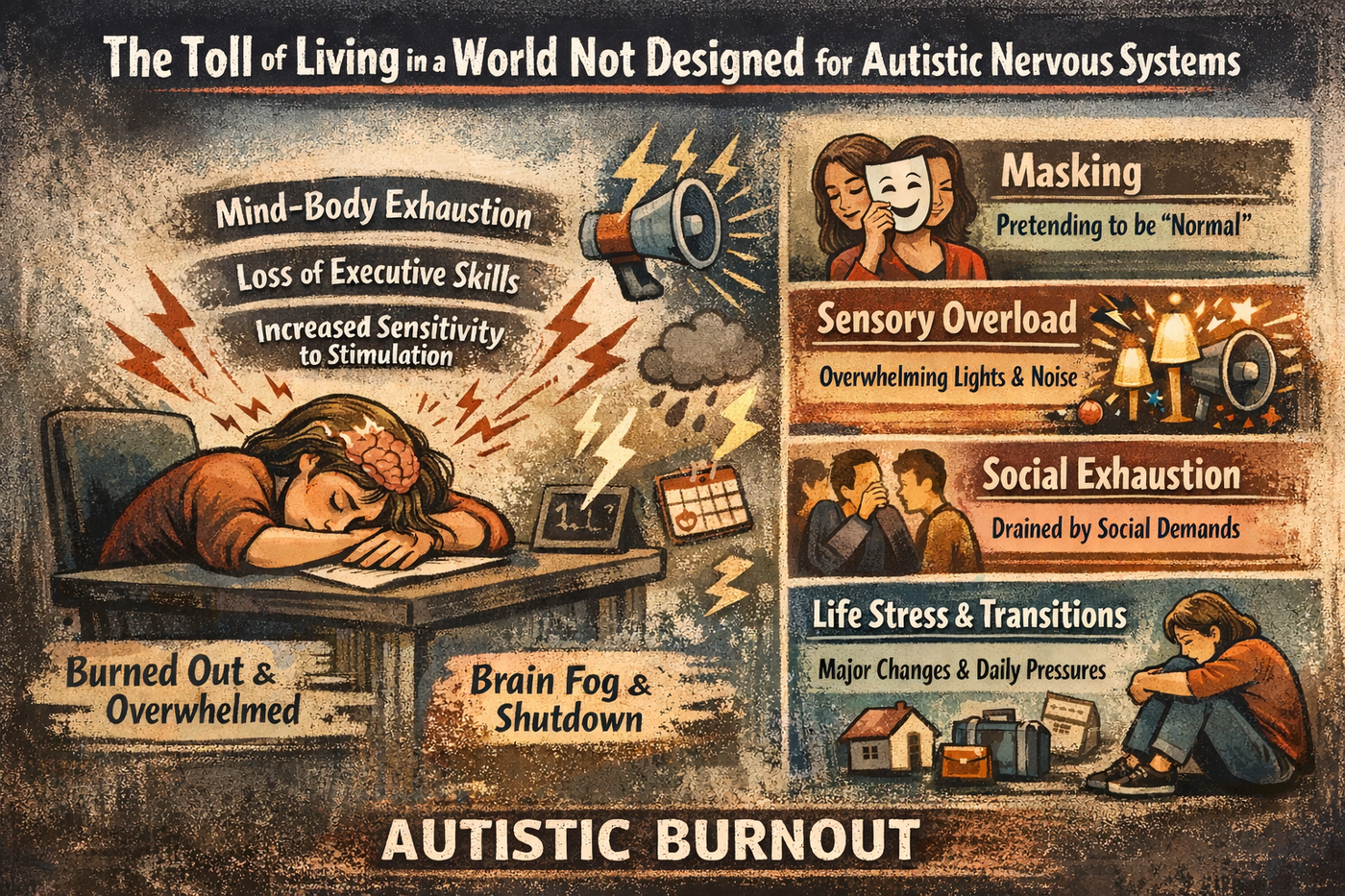
What Is It?
Long-term nervous system exhaustion from living in environments not designed for autistic brains.
More specifically:
Chronic masking (hiding traits to fit in)
Ongoing sensory overwhelm
Constant adaptation to social expectations
What It Looks Like
💤 Deep mind-body exhaustion
🧠 Loss of executive skills (words, focus, planning)
⚡ Increased sensory sensitivity
😶 Reduced tolerance for social interaction
📉 Skills that “used to be easy” feel impossible
It can feel like:
“My system just shut down.”
What Causes It?
Usually a buildup of:
1️⃣ Masking: Constantly monitoring yourself, Forcing eye contact, Suppressing stims, Performing “neurotypical.”
2️⃣ Sensory Overload: Too much:
Light
Noise
Smells
Visual clutter
Social demands
Over time, this drains cognitive energy.
3️⃣ Social Exhaustion: Pushing through the following without enough recovery recovery time”
Group settings
Small talk
Unstructured interactions
4️⃣ Life Stress & Transitions: Big changes or chronic daily stress that exceed capacity:
Moves
Job changes
Relationship shifts
Accumulated responsibilities
Textbook definition
Autistic burnout is a state of profound physical, emotional, and mental exhaustion coupled with a loss of skills, triggered by prolonged stress, sensory overload, and the effort of "masking" to meet neurotypical demands. It differs from depression by being rooted in chronic overtaxing rather than just low mood. Key signs include chronic fatigue, increased sensory sensitivity,, and diminished capacity for daily activities.
Common Signs
Recognizing burnout early can help prevent a total collapse. Look for these key indicators:
Category | Signs & Symptoms |
Cognitive | Brain fog, difficulty making decisions, loss of "executive function" (planning, organizing, starting tasks). Meltdowns or Shutdowns: Having a much lower "fuse" for frustration or simply withdrawing into a catatonic-like state. |
Sensory | Increased sensitivity to noise, light, or touch; feeling "raw" or constantly overstimulated. |
Social | Intense dread of socializing, increased difficulty with speech (going non-speaking or "verbal shutdown"), and reduced ability to mask. |
Physical | Chronic fatigue, physical aches, disrupted sleep, or "autistic catatonia" (feeling unable to move). |
Short Term Strategies to reduce burnout
Immediate "Triage" Strategies
When you are in the thick of it, the goal is energy conservation, not productivity.
Drop the Mask: Allow yourself to stim freely, avoid eye contact, and stop forcing "socially acceptable" facial expressions when alone or with safe people.
Sensory Sanctuary: Create a "low-input" environment. Dim the lights, use noise-canceling headphones, and wear your most comfortable, seamless clothing.
The "No" Rule: Cancel non-essential obligations. If it isn't a "must" for survival (food, basic hygiene, income), it can likely wait.
Low-Demand Living: Use paper plates to avoid dishes, opt for "beige foods" or easy-to-prep meals, and give yourself permission to let the laundry pile up.
and more: Reduced demands, safe unmasking, environmental adjustments
Long Term Strategies for Recovery
Long-Term Recovery & Prevention
Recovery from burnout can take weeks, months, or even longer. It requires a fundamental shift in how you navigate the world.
Identify Energy Leaks: Keep a simple log (when energy allows) of what drains you most. Is it the office lights? Small talk? Transitioning between tasks?
Build "Sensory Buffers": Don't wait for a meltdown to use tools. Wear earplugs in public proactively and schedule "recovery blocks" after social events.
Redefine "Productivity": Transition from a neurotypical standard of "doing more" to an autistic standard of "sustainable rhythm."
Advocacy & Accommodations: Whether at work or home, look for ways to adjust the environment to fit you, rather than forcing yourself to fit the environment.
Burnout Vs Depression
Because autistic burnout involves a loss of skills, it is often misdiagnosed as clinical depression or an anxiety disorder. While they can coexist, the treatment for burnout focuses on reducing demands rather than "pushing through" them.
Autistic Burnout | Depression |
|---|---|
Caused by overload & masking | Mood disorder |
Improves with reduced demands | Often persists despite rest |
Skills temporarily inaccessible | Loss of interest across areas |
Nervous system exhaustion | Emotional + cognitive symptoms |
They can co-occur, but they are not the same.
Demand Avoidance vs Burnout vs Meltdown vs Shutdown
Think of the relationship between these four experiences as an ecosystem of the nervous system. While they are distinct events, they are deeply interconnected, often fueling one another in a cyclical way.
To understand how they relate, it helps to categorize them by their "role" in your internal
Concept | The "Role" | Definition | The Internal Experience |
Demand Avoidance (PDA) | The Protector Demand = Threat = Avoidance | Pathological Demand Avoidance, or more affirmingly, Persistent Drive for Autonomy) is a neurological protection response where the brain perceives a request or "demand" (whether external, like a chore, or internal, like hunger) as a threat to autonomy and safety, triggering an automatic anxiety response, thereby avoiding the demand.
| PDA is often a protective nervous system response designed to prevent or delay:
What It Looks Like
This means PDA is not “won’t” — it’s “can’t until I feel safe again.” |
Meltdown | Energy outward = Nervous system “explosion” | An intense, involuntary external "fight-or-flight" response to sensory or emotional overload. It is a total loss of control where the nervous system "explodes" to release built-up pressure.
| What it can look like
Key truth
What helps
|
Shutdown | Energy Inward = Nervous System “Freeze” | An involuntary "freeze" response where the brain goes offline to protect itself from further input. This results in internalizing the overload, leading to withdrawal, reduced speech, or a "trance-like" state.
| What’s happening internally: What it can look like
Key truth
What helps
|
Burnout | The Climate | A long-term state of total system depletion as a result of the system being consistently overwhelmed without adequate recovery. The "battery" no longer holds a charge, and the threshold for everything else drops: “I’ve been running on empty for too long.” Burnout can increase PDA traits, creating a feedback loop:
| What’s happening internally: Common signs
What helps
|
Neurotypical (Occupational) Burnout Vs Autism
The Key Difference from Work Burnout:
Regular (work) burnout is like running too hard in a race. You recover by stopping the race.
Autistic burnout is like running that race while carrying a heavy backpack, on a broken ankle, and pretending you're fine. Recovery means you must stop the performance entirely, take off the backpack (stop masking), and heal in a safe, quiet space.
Aspect | Neurotypical Burnout | Autistic Burnout |
|---|---|---|
Main Cause | Usually from work: too much stress, pressure, and hours. | From the entire effort of existing in a non-autistic world. It's life burnout. |
Core Triggers | • Work overload | • Constant masking/camouflaging |
Key Symptoms | • Exhaustion | • Severe exhaustion PLUS |
Recovery | Time off, vacation, changing jobs, work-life balance. | Requires deep, prolonged rest in a controlled sensory environment, stopping masking entirely, and often major life adjustments. It's not just a "break from work," but a "break from performing as non-autistic." |
Impact on Identity | "I hate my job." | "I can't remember how to be a person." |
Helpful Resources
The AASPIRE Adult Autism Healthcare Toolkit: Offers practical worksheets for navigating burnout and healthcare.
NeuroQueer / Autistic Advocacy Groups: Community support is often more effective than traditional clinical advice for burnout.
Note: Autistic burnout is often misdiagnosed as clinical depression. While they can co-exist, the "treatment" for burnout is rest and sensory reduction, whereas depression treatment often encourages "behavioral activation" (getting out and doing more), which can actually worsen autistic burnout.
A Note For Clinicians
Clinical Definition of Autistic Burnout
Autistic burnout is a syndrome conceptualized as an overwhelming state of physical, cognitive, and emotional exhaustion observed in autistic individuals. It is characterized by a significant loss of previously acquired skills and reduced tolerance to stimuli, resulting from chronic life stress, a mismatch of expectations and abilities, and the cumulative burden of camouflaging autistic traits and navigating environments that do not accommodate neurodivergent needs.
Core Clinical Features (The "Triad"):
Chronic Exhaustion: Profound and persistent fatigue that is not relieved by ordinary rest, impacting both mental and physical energy reserves.
Reduced Executive Function & Skill Loss: A marked decline in cognitive capacities, including working memory, cognitive flexibility, and emotional regulation. This often manifests as a loss of abilities in activities of daily living (ADLs), such as personal hygiene, meal preparation, or communication (which may include episodes of non-speaking or selective mutism).
Increased Autistic Traits & Sensory Sensitivity: A pronounced withdrawal from social interaction and a significant exacerbation of core autistic features, particularly sensory sensitivities and repetitive behaviors. The individual's capacity to mask or compensate for these traits is severely diminished.
Aetiology (Primary Causes):
Camouflaging (Masking): The sustained effort to suppress autistic behaviors, force eye contact, script social interactions, and mimic neurotypical social cues.
Sensory Overload: Chronic exposure to environments with overwhelming sensory stimuli (e.g., lighting, noise, social chatter) without adequate means to regulate or escape.
Chronic Life Stress & Coping Deficit: The cumulative stress of navigating a world designed for neurotypical people, compounded by a lack of appropriate supports and autistic-specific coping strategies.
Recovery: Clinically, recovery is understood to require an extended period of removal from demanding environments, cessation of camouflaging demands, and access to autism-affirming supports. It is not a short-term recovery but a process of nervous system regulation and skill re-acquisition.
Clinical Comparison: Autistic Burnout vs. Occupational Burnout
Feature | Autistic Burnout | Occupational Burnout (Per ICD-11/WHO) |
|---|---|---|
Formal Recognition | An emerging, community-derived syndrome; not yet a formal diagnosis in major manuals (DSM-5/ICD-11), but a focus of ongoing clinical research. | A syndrome (QD85) in the ICD-11, classified as an occupational phenomenon. |
Diagnostic/Descriptive Criteria | Proposed Core Triad: | ICD-11 Core Triad: |
Primary Context | Pervasive across life domains (social, sensory, cognitive, occupational). Results from the strain of existing as an autistic person in a neurotypical world. | Specifically tied to the context of work. It is not applied to experiences in other life domains. |
Key Aetiological Stressor | Camouflaging/Masking: The effort to hide autistic traits and appear neurotypical. Chronic sensory & social stress. | Chronic workplace stress that has not been successfully managed. Mismatch between job demands and resources. |
Pathognomonic Feature | Loss of previously mastered adaptive skills (e.g., self-care, speech) and acute exacerbation of autistic traits (sensory sensitivity, social withdrawal). | Cynicism & detachment specifically directed toward one's job or professional role. |
Cognitive Impact | Global executive dysfunction: Impairments in memory, processing speed, and problem-solving that affect all aspects of life. | Job-specific cognitive impairment: Reduced efficacy, productivity, and engagement within the occupational role. |
Recovery Focus | Identity-affirming rest: Requires a safe, low-demand environment where the individual can stop masking and engage in self-regulated, autistic-normative behaviors. Often necessitates systemic accommodations. | Workplace interventions & detachment: Focuses on changes to the work environment, workload management, and psychological detachment from job stressors during non-work time. |
In Summary for Clinicians: While both involve exhaustion, autistic burnout is distinguished by its pervasive, life-domain-wide functional decline, its root in identity suppression (camouflaging), and its hallmark feature of skill regression and trait exacerbation. It is a systemic nervous system collapse from the cumulative strain of adapting to a neurotypical world, whereas occupational burnout is a syndrome of disillusionment and exhaustion localized to the work context.
